
Words to describe art: 200 words by category
“Beautiful” and “interesting” say nothing about a painting. The words that help are the ones that point at something you can see: a colour, a kind of light, where things sit in the frame, how the paint is put on. Here they are, grouped the way you actually look at a picture.
Colour
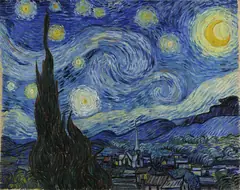
Example: “The Starry Night is built on a contrast of deep cobalt blue and lemon yellow.”
Temperature: warm, cool, cold, fiery, icy, sun-baked
Strength: vivid, vibrant, saturated, bold, intense, muted, faded, washed-out, soft, pastel, dull, subdued
Families: earthy, ochre, rust, olive, teal, turquoise, ultramarine, cobalt, crimson, scarlet, vermilion, lemon, golden, ivory, charcoal, sepia
Relationships: monochrome, harmonious, contrasting, complementary, limited palette, clashing, tonal, colour accents
Light and shadow
Example: “In The Milkmaid, soft daylight falls from a window on the left and makes the white wall glow.”
Kinds of light: soft, harsh, diffused, dappled, glowing, luminous, flickering, candlelit, moonlit, backlit, overcast, golden-hour
Direction: from the left, from above, from behind, from a window, from a single source, rim light
Shadow: deep, long, cast, soft-edged, sharp, dramatic, murky, shadowy
Effects: chiaroscuro, silhouette, highlight, reflection, glare, haze, mist, gloom
Composition: where things are
Example: “The Great Wave fills the left of the picture and curls over three small boats, with a tiny snowy mountain low in the background.”
Planes: foreground, middle ground, background, horizon, vanishing point, depth
Position: centred, off-centre, in the lower third, in the top right corner, framed by, overlapping, cropped at the edge
Structure: symmetrical, asymmetrical, balanced, diagonal, triangular, circular, crowded, sparse, open, enclosed
Viewpoint: eye level, bird’s-eye view, low angle, close-up, wide view, panoramic
Brushwork and texture
Example: “Seurat builds A Sunday on La Grande Jatte out of tiny dots of pure colour.”
Paint: thick, thin, impasto, smooth, glossy, matte, layered, translucent, opaque
Strokes: swirling, loose, tight, sketchy, feathery, dabbed, stippled, dotted, energetic, visible, invisible
Line: fluid, jagged, sharp, delicate, bold outlines, flat areas of colour
Surface: rough, grainy, polished, cracked, gilded, patterned, decorative
Mood and atmosphere
Mood words work best after you have described what is in the picture. Our guide to describing a painting explains why.
Calm: serene, peaceful, still, tranquil, quiet, dreamy, gentle, contemplative
Dark: eerie, ominous, melancholic, lonely, bleak, haunting, sombre, uneasy
Bright: joyful, lively, festive, playful, carefree, exuberant, warm-hearted
Tense: dramatic, stormy, turbulent, anxious, chaotic, restless, explosive
Style words
How real it looks: realistic, lifelike, naturalistic, stylised, simplified, exaggerated, abstract, dreamlike, surreal, naive
Periods and movements: Renaissance, Baroque, Romantic, Realist, Impressionist, Post-Impressionist, Pointillist, Expressionist, Art Nouveau, Cubist, Suprematist
Media: oil on canvas, tempera, fresco, watercolour, gouache, pastel, charcoal, ink, woodblock print, etching, mixed media
Key terms, briefly
| Term | What it means |
|---|---|
| Chiaroscuro | Strong contrast of light and dark to model shapes, as in Caravaggio or Rembrandt. |
| Impasto | Paint laid on so thickly that the strokes stand up from the surface. |
| Sfumato | Soft, smoky transitions without hard outlines — the haze around the Mona Lisa’s face. |
| Pointillism | Painting with small dots of pure colour that mix in the viewer’s eye. |
| Palette | The set of colours an artist uses in a picture. |
| Composition | How the parts of a picture are arranged. |
| Perspective | The way depth is shown: lines meeting at a vanishing point, smaller and paler things further away. |
| Foreshortening | Drawing something pointing toward the viewer so it looks shortened. |
| Negative space | The empty areas around and between the subjects. |
| Focal point | The place the eye goes first. |
| Glaze | A thin transparent layer of paint over another colour. |
| Triptych | A painting in three panels, often hinged. |
| Genre scene | A painting of everyday life. |
| Still life | A painting of arranged objects: fruit, flowers, dishes. |
Describing a painting in one word
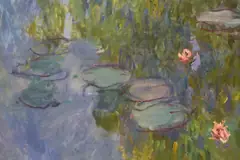
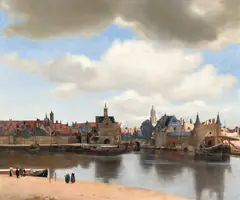
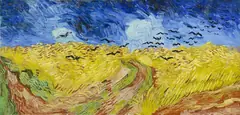
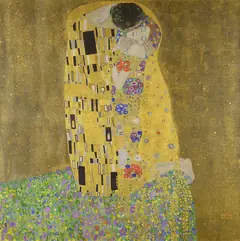
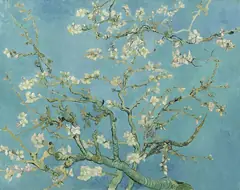
Sometimes you need a single word — for a caption, a quiz or a game. Pick one that points at something visible: luminous (Water Lilies), turbulent (The Starry Night), serene (View of Delft), ominous (Wheatfield with Crows), gilded (The Kiss), stark (Black Square), tender (Almond Blossom).
Put the words to work
Vocabulary sticks when you use it under a little pressure. In Speakasso you get 20 seconds to describe a famous painting without its forbidden words, and an AI paints what you said. “Dappled light”, “off-centre”, “thick swirling strokes” — you see at once which words the AI turned into paint. The same words also make better AI art prompts.
Try it in Speakasso
Describe masterpieces with these words and see what AI paints from them. Speakasso is an Android game in English and Russian, coming soon to Google Play.
Questions
What are good words to describe a painting?
Words that point at something visible: colours (cobalt, ochre, muted, vivid), light (soft, dappled, backlit), composition (foreground, off-centre, diagonal), brushwork (thick, swirling, smooth) and, last, mood (serene, eerie, joyful).
How do you describe art in one word?
Choose a word tied to what you see rather than a general compliment: luminous, turbulent, serene, ominous, gilded, stark.
What is the difference between tone and colour?
Colour is the hue — blue, red, yellow. Tone is how light or dark it is. A painting can use one colour in many tones, which is what monochrome means.