
AI drawing games: you describe, AI draws
There are two kinds of AI drawing game. In one, you draw and the AI guesses. In the other, you talk and the AI draws. The second kind is newer, stranger and much harder than it looks — because the AI takes every word you say literally.
Two kinds of AI drawing game
AI guesses your drawing. The best-known example is Google’s Quick, Draw!: you get a word and 20 seconds to doodle it, while a neural network trained on millions of doodles calls out what it thinks you are drawing. It is fun for a few minutes, and it shows how AI recognises shapes.
AI draws from your words. Here you are the one giving the description, and an AI image generator turns it into a picture. This is the same technology people use to write prompts for image generators, turned into a game: you have a target, a time limit and a score. Some people call it AI Pictionary — the guessing is gone, but the challenge of getting an image across under pressure is the same.
How a round of Speakasso works
The 100 points are split the way a picture is built: 50 for what is painted (the subject, its pose, the details), 20 for where things are, 20 for colour and light, and 10 for style. After every round you see what the AI heard and where the points went.
- Look. A famous painting appears for a few seconds: Van Gogh, Hokusai, Vermeer, Munch. Remember what is where.
- Describe. By voice or by typing, up to 20 seconds: who or what is there, where it is, which colours and light.
- Don’t name it. The title, the artist and the key objects are forbidden words. Each one costs 15 points.
- Compare. AI paints your version and your rival’s. An AI judge compares both with the original and scores each from 0 to 100.
Why describing a picture to AI is hard
When we look at a famous painting, we recognise it and want to say its name. But the name is exactly what you can’t use, and it wouldn’t help anyway: an image generator draws what you describe, not what you mean. Three things trip people up:
- Mood instead of objects. “A dramatic, mysterious picture” gives the AI nothing to draw. “A pale woman in a dark doorway, lit from the left” does.
- No layout. If you don’t say where things are, the AI puts them wherever it likes. Left, right, foreground and background are worth 20 points.
- Details before the main subject. Twenty seconds go fast. Say the big thing first, then add what makes this picture unique.
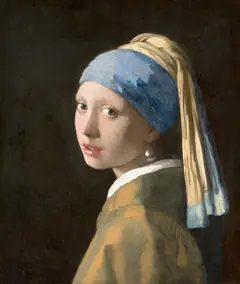
An example: Girl with a Pearl Earring
A weak description: “A famous Dutch portrait of a girl, very beautiful, looking at us.” The AI draws a generic pretty girl, and “Dutch” doesn’t help much.
“A young woman against a completely black background, turning her head over her left shoulder to look straight at us, lips slightly open. Her head is wrapped in blue and yellow cloth with a long yellow tail hanging down, a big shiny white drop hangs from her ear, and she wears a brownish-yellow jacket with a white collar. Soft light from the left.”
The second version names nothing forbidden and gives the AI the subject, the pose, the colours, the light and the one detail everyone remembers. That is the whole method in one example; the full version is in our guide to describing a painting.
What you get better at
- Describing precisely — the skill behind good speaking, good writing and good AI art prompts.
- Vocabulary — colours, light, composition, texture. Our list of words to describe art collects the ones that score.
- Art — along the way you get to know hundreds of famous paintings and their artists. Try the famous paintings quiz to see how many you already know.
- English or Russian — you can play in either language, which makes it a practice tool too: see how to describe a picture in English.
Ways to play
- Duels with friends — send a link in any messenger; your friend opens it and you can duel right away. Your head-to-head score is kept.
- Online duels — play rivals and take your rematch.
- Practice with Ino — a friendly crystal that shows you how to describe more precisely.
- Collection, leagues and streaks — collect paintings into albums, climb the weekly leagues and keep your day streak.
Try it in Speakasso
Describe famous paintings and see what AI draws from your words. Speakasso is an Android game in English and Russian, coming soon to Google Play.
Questions
Is there a game where AI draws what you say?
Yes. In Speakasso you describe a famous painting by voice or by typing, an AI image generator draws a picture from your words, and an AI judge scores how close it is to the original.
Do I need to be able to draw?
No. The AI does all the drawing. The skill is describing what you see.
Can I type instead of speaking?
Yes. You can switch to typing at any time; the rules and points are the same.
Is it on iPhone?
Not yet. Speakasso is an Android app (Android 8.0 or newer).
What is AI Pictionary?
An informal name for games where AI takes part in the drawing and guessing: either the AI guesses your drawing, or it draws from your description. Speakasso is the second kind.