Speakasso › Paintings › Girl with a Pearl Earring
Girl with a Pearl Earring
Johannes Vermeer, 1665
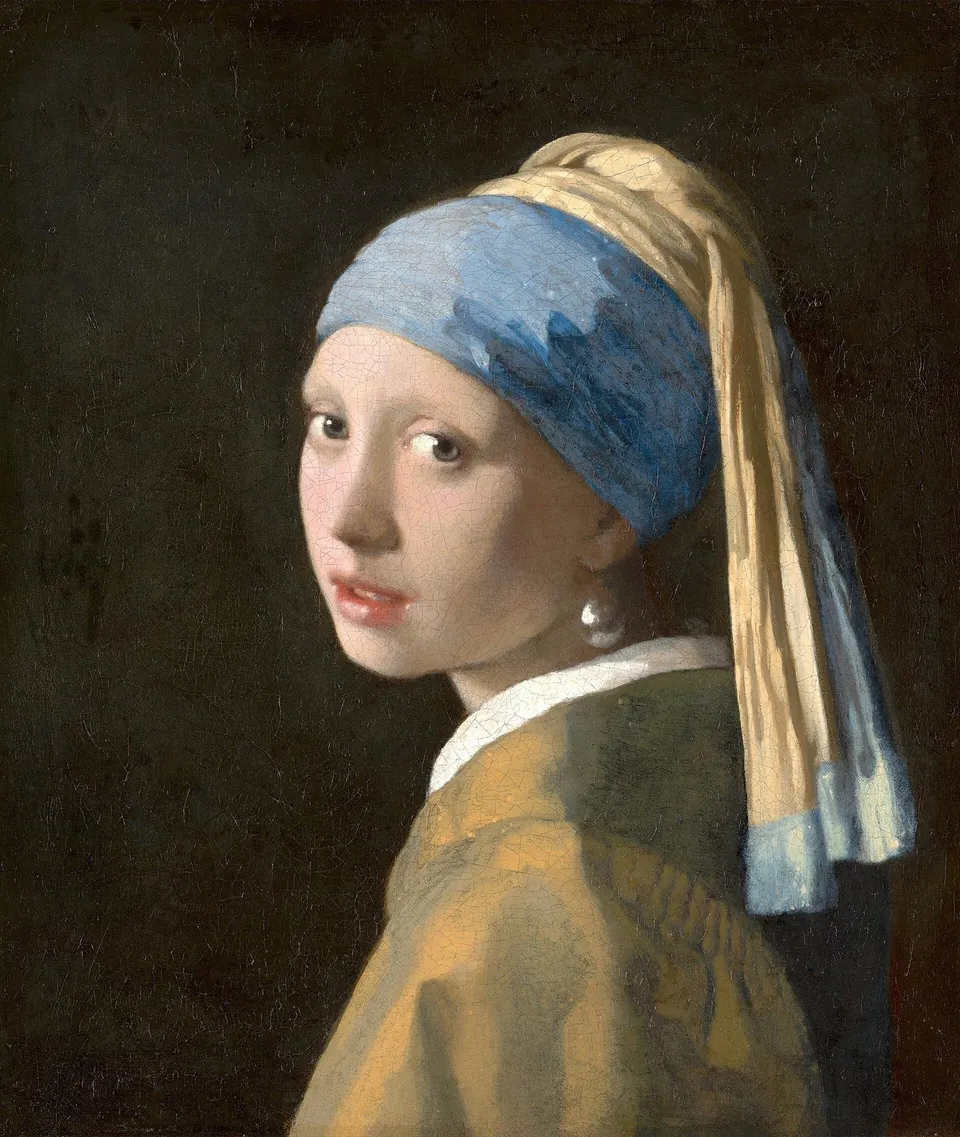
Not a portrait but a tronie, a study of a head in fancy dress, the kind of picture Dutch buyers hung at home for pleasure. The girl turns over her shoulder as if just called, lips parted, a large earring glinting at her ear. The blue-and-yellow turban is pure exotica; no one in Delft dressed like that. The background, now nearly black, was originally a dark green curtain. We do not know who she is; perhaps no one in particular. That very uncertainty made the picture the 'Mona Lisa of the North'.
What is in the painting
- Glance over the shoulder. The girl turns her head toward you while her body faces away.
- Blue and yellow. A blue cloth wraps her head, with a yellow tail hanging down behind.
- Highlight on the earring. A large pearl hangs from her ear with a single bright highlight.
Did you know? In 1881 the picture sold at a Hague auction for two guilders and thirty cents, less than the price of a good dinner.
About the painting
- Artist
- Johannes Vermeer (1632–1675)
- Year
- 1665
- Style
- Dutch Golden Age
- Medium
- Oil on canvas
- Size
- 44.5 × 39 cm
- Where to see it
- Mauritshuis, The Hague
How to describe it in Speakasso
In Speakasso you describe the painting in your own words and an AI draws it again. These words are forbidden in this round — each one costs 15 points:
A description that scores high
A young woman is shown from the shoulders up, her body turned away but her head glancing back at us over her shoulder, lips slightly parted. A bright blue cloth is wrapped around her head, with a yellow fabric tail hanging down behind. A big shiny silver-grey drop hangs from her ear with one white highlight. Plain, nearly pitch-dark backdrop, soft light from the left. Smooth, glowing old Dutch oil painting.
The tricky part: Describe the headwear as a blue cloth wrapped around her head with a yellow tail, and the jewel as a shiny drop at her ear.
The method behind it: what is painted first, then where things are, then colour and light, then the style. Read the full guide
More by Johannes Vermeer in the game