
Speakasso › Paintings › The Great Wave off Kanagawa
The Great Wave off Kanagawa
Katsushika Hokusai, 1831
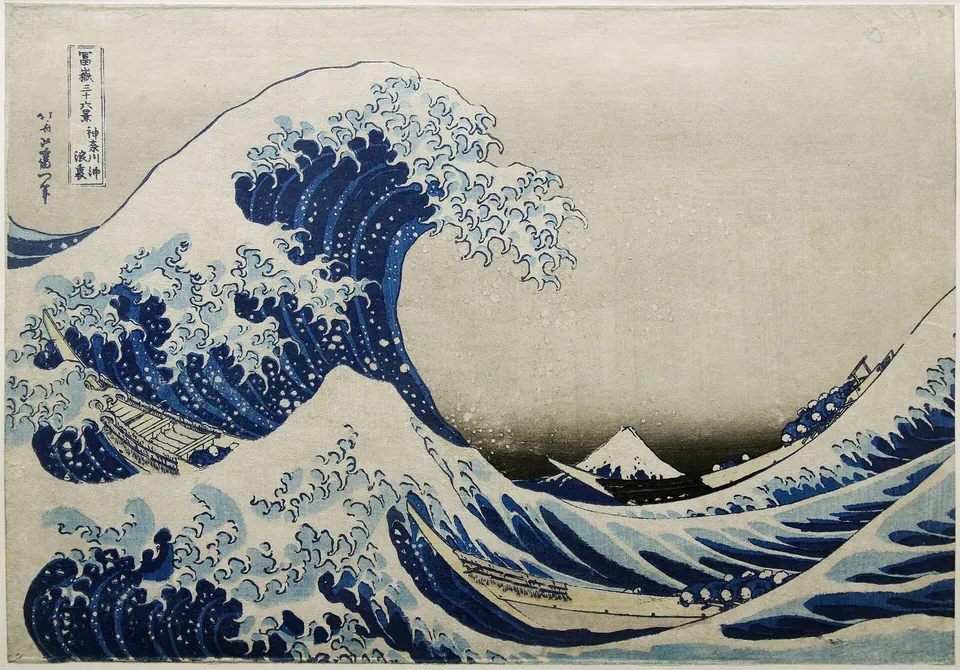
A giant wave with foaming 'claws' looms over three boats full of rowers, while far away, small and calm, stands snow-white Fuji. This is the first sheet of 'Thirty-six Views of Mount Fuji', a series Hokusai began in his seventies. The deep blue is Prussian blue, a pigment recently imported into Japan, and its novelty was part of the appeal. The print was pulled in thousands of impressions and sold for about the price of a bowl of noodles; surviving copies now sit in the world's great museums. Debussy put it on the cover of his score 'La Mer'.
What is in the painting
- Foam claws. The crest breaks into white fingers reaching for the boats.
- Three boats. Long narrow boats with crouching rowers plunge through the waves.
- Tiny Fuji. A snow-capped mountain sits beneath the curl of the wave at centre.
Did you know? Of the thousands of impressions printed, only around a hundred are thought to survive today.
About the painting
- Artist
- Katsushika Hokusai (1760–1849)
- Year
- 1831
- Style
- Ukiyo-e
- Medium
- Colour woodblock print
- Size
- 26 × 38 cm
- Where to see it
- Metropolitan Museum of Art, New York
How to describe it in Speakasso
In Speakasso you describe the painting in your own words and an AI draws it again. These words are forbidden in this round — each one costs 15 points:
A description that scores high
A giant curling wall of deep blue water rises on the left and arches over the whole scene, its white foamy crest breaking into claw-like fingers. Below it, three long narrow rowing vessels full of crouching men plunge through the rough sea. Far away in the center, framed under the curl, sits a small snow-capped peak. Prussian blue, white foam and a pale beige sky. Flat Japanese woodblock print look with crisp outlines.
The tricky part: Say a huge curling wall of blue water with white claw-like foam, and call the vessels long narrow rowing craft.
The method behind it: what is painted first, then where things are, then colour and light, then the style. Read the full guide