Speakasso › Paintings › The Birth of Venus
The Birth of Venus
Sandro Botticelli, 1480
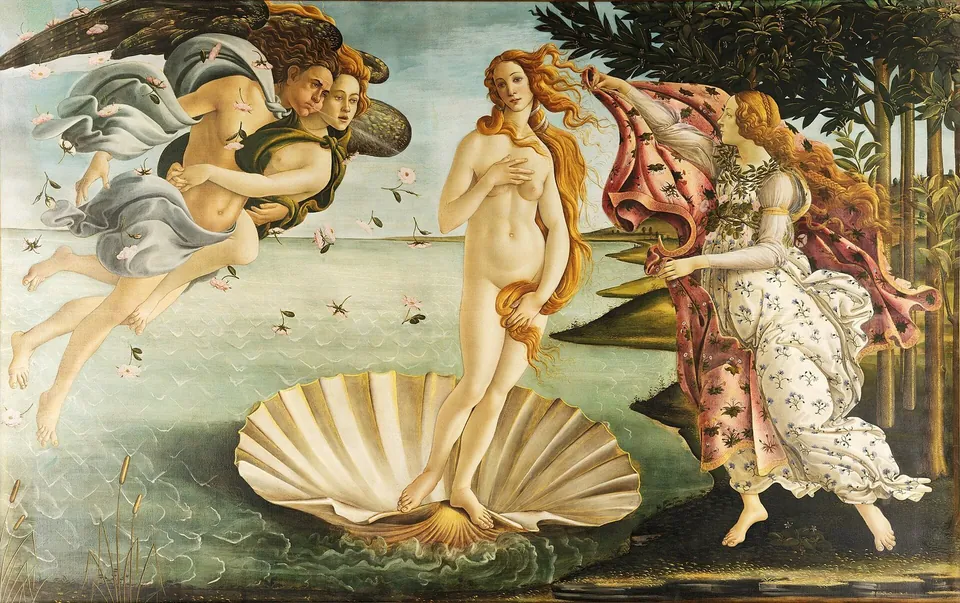
The goddess of love, newly born from sea foam, drifts to shore standing on an enormous scallop shell. On the left the winds push her along, Zephyr entwined with a nymph; on the right a Hora of spring hurries forward with a flower-strewn cloak. One of the first large Renaissance paintings with a nude classical goddess at its centre, it was made for the Medici family. Botticelli stretched Venus's neck and dropped her shoulder: anatomy yields to a flowing, musical line. Unusually for Florence, it is on canvas, not panel.
What is in the painting
- Flowing hair. Golden strands blow across the goddess's body, and she holds them with one hand.
- Falling flowers. Pink roses tumble through the air around the blowing couple.
- Flat sea. Greenish water marked with small V-shaped waves, and a strip of shore with trees on the right.
Did you know? The composition is thought to answer an ancient description of a lost painting by the Greek artist Apelles showing Aphrodite rising from the sea.
About the painting
- Artist
- Sandro Botticelli (1445–1510)
- Year
- 1480
- Style
- Early Renaissance
- Medium
- Tempera on canvas
- Size
- 172.5 × 278.9 cm
- Where to see it
- Uffizi Gallery, Florence
How to describe it in Speakasso
In Speakasso you describe the painting in your own words and an AI draws it again. These words are forbidden in this round — each one costs 15 points:
A description that scores high
A tall nude goddess with very long red-gold hair stands in the center on a huge pale scallop floating on the sea. On the left, two winged figures hug each other and blow her toward shore, with pink roses tumbling around them. On the right, a young attendant hurries up holding out a robe covered in tiny blossoms. Pale green water with small V-shaped ripples, smooth delicate old Italian painting.
The tricky part: Call what she stands on a giant ribbed, fan-shaped scallop floating on the sea, and the ripples small V-shaped marks.
The method behind it: what is painted first, then where things are, then colour and light, then the style. Read the full guide