
Speakasso › Paintings › The Creation of Adam
The Creation of Adam
Michelangelo, 1511
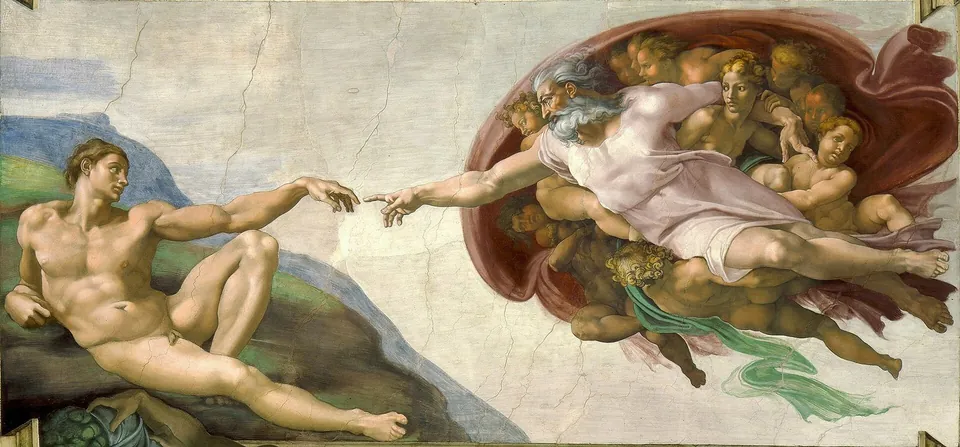
One of nine scenes from Genesis on the vault of the Sistine Chapel, which Michelangelo painted for Pope Julius II over four years, working from scaffolding with his head thrown back. A naked Adam lounges on a slope while a white-bearded God sweeps toward him in a swirl of purple drapery, surrounded by angels. Two index fingers almost touch: that tiny gap has become the most famous gesture in painting. Michelangelo thought of himself as a sculptor and took the commission reluctantly.
What is in the painting
- The gap. A narrow sliver of empty space separates the two outstretched fingers.
- Two poses. Adam reclines limply; God strains forward in flight, arm extended.
- Purple cocoon. God and the angels are wrapped in a billowing, cloud-like mantle of dusky pink.
Did you know? In 1990 the physician Frank Meshberger pointed out that the outline of the cloak around God and the angels matches a cross-section of the human brain.
About the painting
- Artist
- Michelangelo (1475–1564)
- Year
- 1511
- Style
- High Renaissance
- Medium
- Fresco
- Size
- 280 × 570 cm
- Where to see it
- Sistine Chapel, Vatican Museums, Vatican City
How to describe it in Speakasso
In Speakasso you describe the painting in your own words and an AI draws it again. These words are forbidden in this round — each one costs 15 points:
A description that scores high
On the left, a naked young man lounges on a green slope, reaching out limply toward the right. On the right, a white-haired old man with long white whiskers flies toward him, straining forward, wrapped in a billowing dusky pink cloud full of little angels. Their two pointing digits almost meet in the middle, leaving a tiny gap. Muscular bodies, pale grey-blue sky, soft fresco colors like a chapel ceiling.
The tricky part: The key moment is the gap: say both men reach toward each other and their pointing digits almost meet in the center, with a sliver of air between.
The method behind it: what is painted first, then where things are, then colour and light, then the style. Read the full guide