Speakasso › Paintings › Las Meninas
Las Meninas
Diego Velázquez, 1656
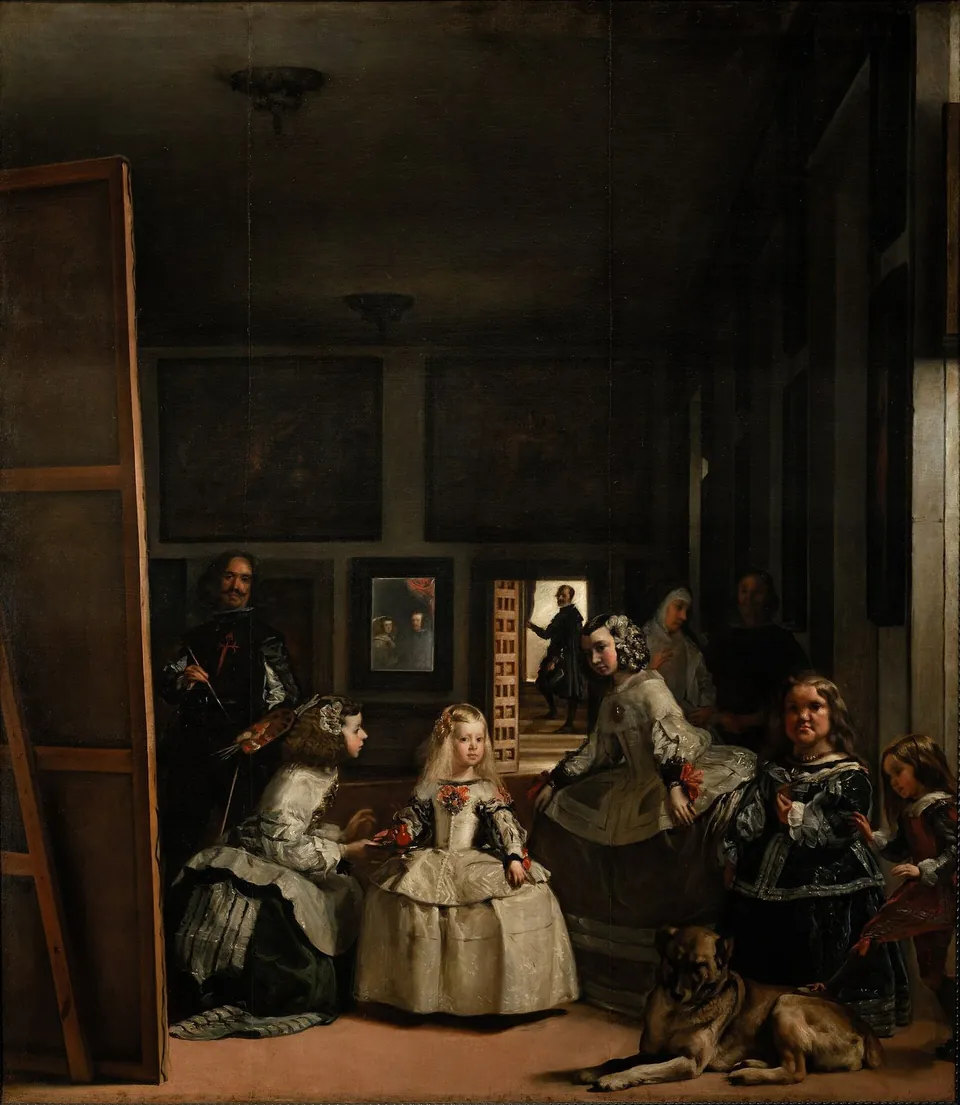
In a large, dim room of the Alcázar stands the five-year-old Infanta Margarita, surrounded by her ladies-in-waiting, two dwarfs and a drowsy mastiff. At the left, behind a huge canvas, Velázquez himself holds a brush, while the mirror on the back wall reflects the king and queen. Who is posing here, and who is watching? The painting makes the viewer a participant and has unsettled philosophers and painters for three and a half centuries; Picasso alone made fifty-eight variations on it. Luca Giordano called it 'the theology of painting'.
What is in the painting
- Girl at the centre. A small fair-haired girl in a wide white dress, two ladies bending toward her.
- Painter at his canvas. At the left a tall man in black with palette and brush stands before a huge canvas seen from behind.
- Light in the doorway. Far back, a man on a staircase stands in a brightly lit open doorway.
Did you know? The red cross of the Order of Santiago on Velázquez's chest was added later: he was admitted to the order only in 1659, three years after the painting was finished.
About the painting
- Artist
- Diego Velázquez (1599–1660)
- Year
- 1656
- Style
- Baroque
- Medium
- Oil on canvas
- Size
- 318 × 276 cm
- Where to see it
- Museo del Prado, Madrid
How to describe it in Speakasso
In Speakasso you describe the painting in your own words and an AI draws it again. These words are forbidden in this round — each one costs 15 points:
A description that scores high
A little blonde princess in a wide white gown stands in the middle of a dim palace room, two maids bending toward her. On the left, a tall painter in black with a brush stands beside a huge canvas seen from behind. Front right, two dwarfs and a big sleepy hound. At the back, a small framed glass shows a royal couple, and a man stands in a bright open passage. Loose realistic oil painting.
The tricky part: Say a small framed glass on the back wall shows a king and queen, next to a bright opening with a man on steps.
The method behind it: what is painted first, then where things are, then colour and light, then the style. Read the full guide
More by Diego Velázquez in the game