
Speakasso › Paintings › American Gothic
American Gothic
Grant Wood, 1930
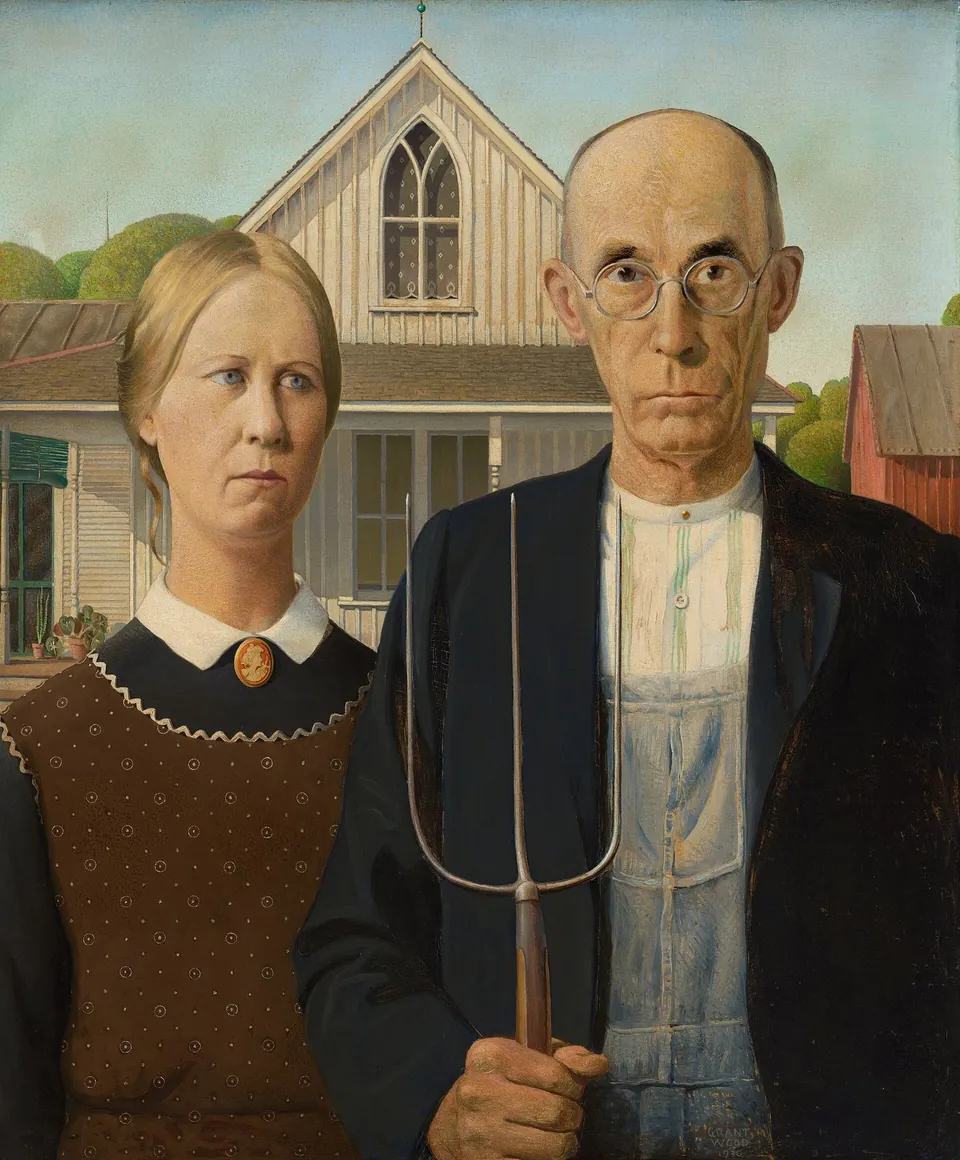
Driving through the small town of Eldon, Iowa, Grant Wood spotted a little white house with a Gothic window and decided to paint the sort of people who might live in it. His sister Nan and the family dentist Byron McKeeby posed. Stern faces, a pitchfork, clothes buttoned to the neck: the picture provoked argument at once. Some saw mockery of rural life, others a hymn to the sturdy American farmer. Wood insisted he painted with affection. Today it is probably the most parodied painting in the United States.
What is in the painting
- Echoing shapes. The prongs of the pitchfork are repeated in the overall seams and the narrow window.
- Sideways glance. The man stares straight at us; the woman looks off to the side.
- Small details. A cameo brooch, a stray curl, potted plants on the porch, all painted with jeweller's precision.
Did you know? At the 1930 Chicago exhibition the painting won a bronze medal and a $300 prize, and the museum bought it immediately.
About the painting
- Artist
- Grant Wood (1891–1942)
- Year
- 1930
- Style
- Regionalism
- Medium
- Oil on beaverboard
- Size
- 78 × 65.3 cm
- Where to see it
- Art Institute of Chicago, Chicago
How to describe it in Speakasso
In Speakasso you describe the painting in your own words and an AI draws it again. These words are forbidden in this round — each one costs 15 points:
A description that scores high
A stern elderly farmer and a younger woman stand side by side, facing us. He wears round wire-rimmed spectacles, a dark jacket and overalls, and holds a long three-pronged farm tool upright. She wears a dark dress with a white collar and a brooch, and glances off to the side. Behind them is a white farm cottage with a pointed church-style window. Clear blue sky, crisp even light, smooth, super-detailed painting.
The tricky part: Call the tool a long three-pronged farm tool held upright, and the eyewear round wire-rimmed spectacles.
The method behind it: what is painted first, then where things are, then colour and light, then the style. Read the full guide