Speakasso › Paintings › The Kiss
The Kiss
Gustav Klimt, 1907
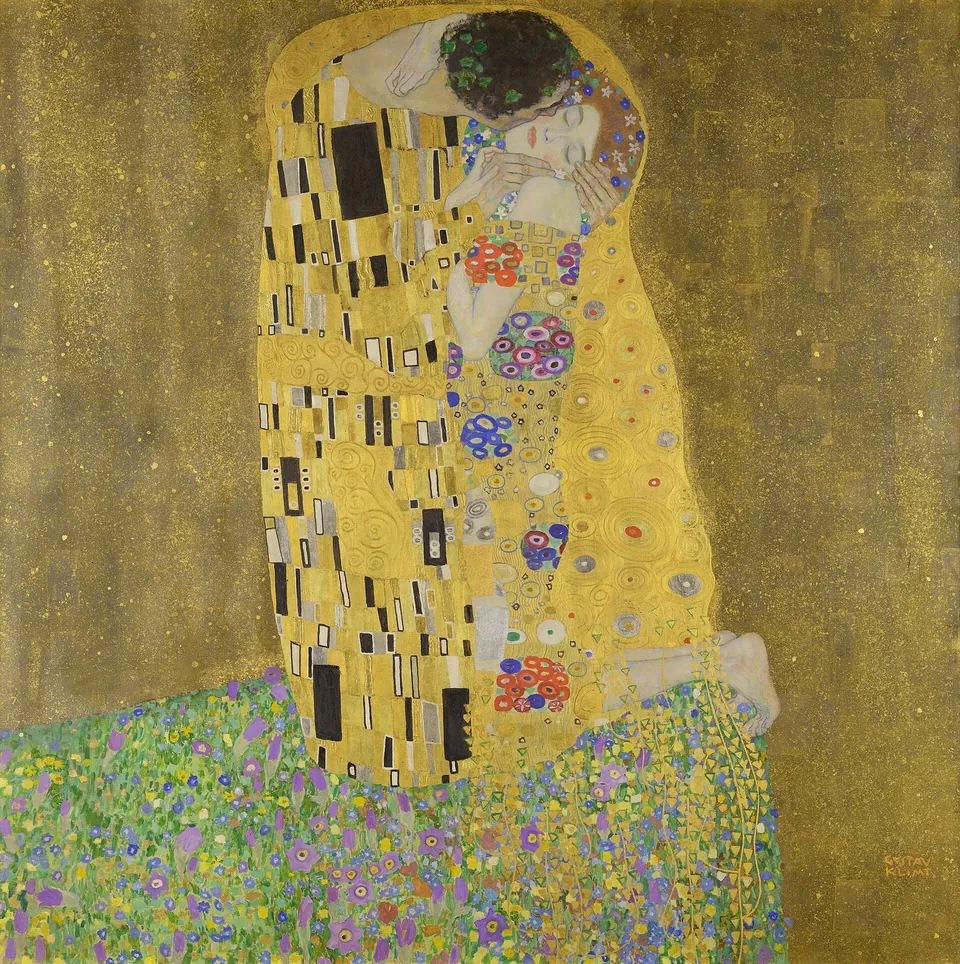
The summit of Klimt's golden period: two lovers at the edge of a flowering meadow have merged into a single golden shape, with only faces and hands painted as living flesh. The man bends to the woman's cheek; she kneels, her toes gripping the very edge of the cliff. His robe carries stern black-and-white rectangles, hers circles and flowers, male and female fused into one figure. Klimt used real gold leaf, recalling his engraver father's craft. The Austrian state bought it before it was even finished.
What is in the painting
- Golden cocoon. The couple is wrapped in one shared golden mantle, so their bodies almost disappear.
- Cliff edge. They stand on a bright flowery meadow that breaks off sharply at the woman's feet.
- Rectangles and circles. His robe is patterned with black-and-white rectangles, hers with coloured circles and blooms.
Did you know? The state bought The Kiss in 1908 for 25,000 crowns, several times more than had ever been paid for a painting by an Austrian artist.
About the painting
- Artist
- Gustav Klimt (1862–1918)
- Year
- 1907
- Style
- Art Nouveau, Vienna Secession
- Medium
- Oil and gold leaf on canvas
- Size
- 180 × 180 cm
- Where to see it
- Belvedere, Vienna
How to describe it in Speakasso
In Speakasso you describe the painting in your own words and an AI draws it again. These words are forbidden in this round — each one costs 15 points:
A description that scores high
A man and a woman embrace in the center, wrapped together in one shimmering robe of yellow metal, so their bodies almost vanish. He bends and presses his lips to her cheek; she kneels, face tilted up. His side is covered in black-and-white rectangles, hers in colorful circles. They are on a bright meadow of tiny blooms that ends in a sharp drop. Flat decorative painting with real metal leaf.
The tricky part: Describe the shine instead of naming the metal: one glittering yellow robe, like foil, wrapped around both of them.
The method behind it: what is painted first, then where things are, then colour and light, then the style. Read the full guide
More by Gustav Klimt in the game