Speakasso › Paintings › The Scream
The Scream
Edvard Munch, 1893
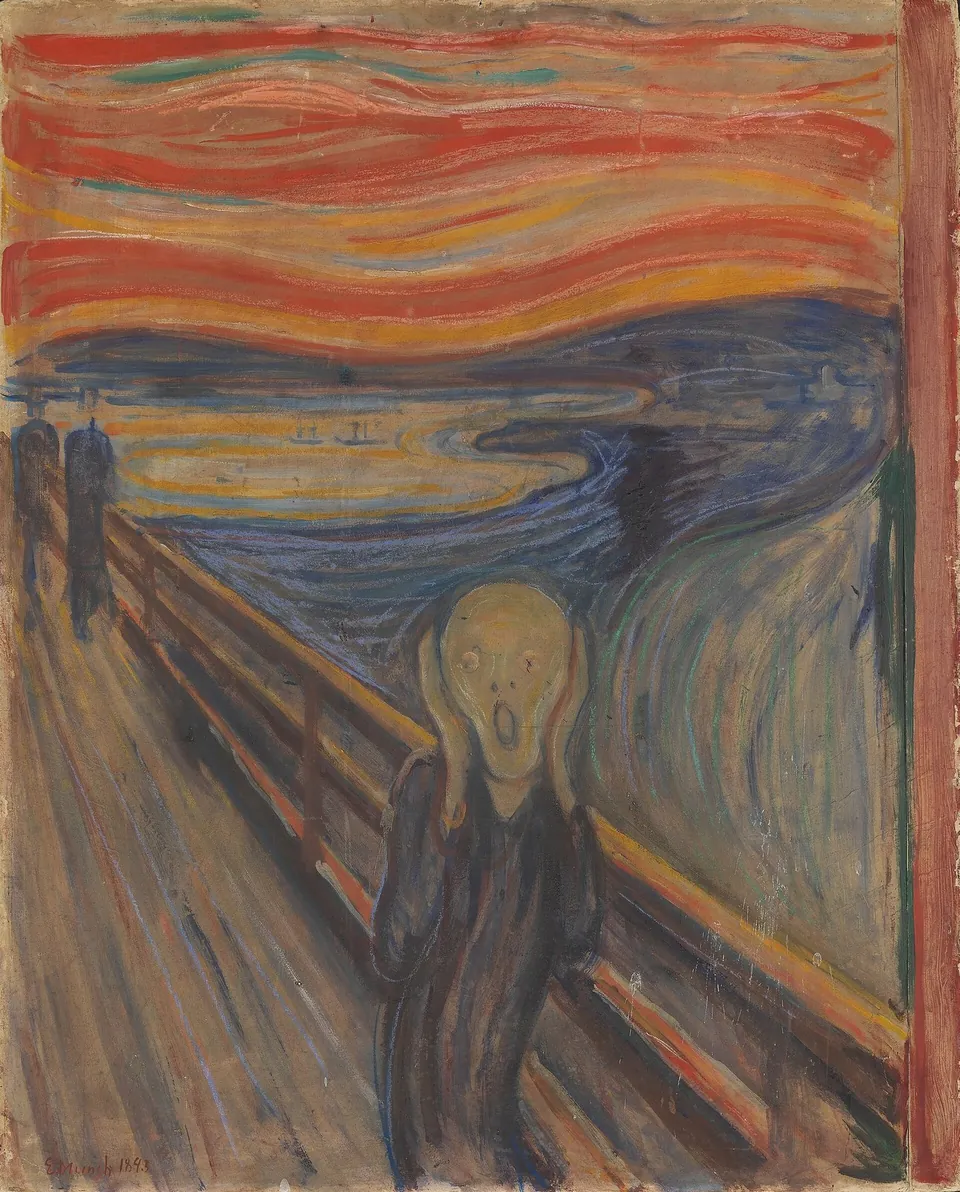
Munch recalled walking with friends one evening on a road above the fjord near Oslo when the sky turned blood-red and he felt a great scream passing through nature. From that memory came this picture of 1893: a sexless figure with a skull-like head clutches its ears on a bridge while the whole landscape ripples in wavy lines as if screaming too. Two companions walk on, noticing nothing. Munch made four painted versions and a lithograph; this earliest one is on cardboard. It is perhaps art's defining image of anxiety.
What is in the painting
- Wavy sky. The sky is painted in orange-red and yellow waves that echo the curves of the fjord.
- Figure on the bridge. A thin hairless figure in dark clothes presses its hands to its cheeks, eyes and mouth wide open.
- Two in the distance. Two people in hats walk away along the diagonal of the bridge.
Did you know? A pencil inscription in the top corner reads 'Could only have been painted by a madman'; in 2021 experts confirmed the handwriting is Munch's own.
About the painting
- Artist
- Edvard Munch (1863–1944)
- Year
- 1893
- Style
- Expressionism
- Medium
- Tempera, oil and pastel on cardboard
- Size
- 91 × 73.5 cm
- Where to see it
- National Museum of Norway, Oslo
How to describe it in Speakasso
In Speakasso you describe the painting in your own words and an AI draws it again. These words are forbidden in this round — each one costs 15 points:
A description that scores high
A thin bald figure with a pale skull-like face stands up front, pressing both hands to its cheeks, jaw dropped open in horror. It stands on a long wooden walkway whose railing runs diagonally back to the left, where two people in hats walk away. The whole upper part swirls in wavy bands of blood orange and yellow over a dark blue fjord and hills. Loose, rough, flowing brushstrokes, as if everything is shaking.
The tricky part: Skip naming the sound and describe the gesture: hands pressed to the cheeks, jaw dropped, a bald skull-like head.
The method behind it: what is painted first, then where things are, then colour and light, then the style. Read the full guide
More by Edvard Munch in the game