
How to describe a picture in English
Describing a picture is one of the most common speaking tasks — in exams, in English classes and in real life. The trick is not a big vocabulary, it is a structure: once you know what to say first, second and third, the words come much more easily. Here is that structure, the phrases that go with it, a model answer and a way to practise with instant feedback.
The five-step structure
This order works because it goes from big to small. A listener (or an examiner, or an AI) understands the whole scene first and then the details slot into place.
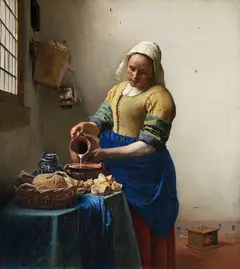
- Say what it is. One sentence of overview: “This is a painting of a woman pouring milk in a kitchen.”
- The main subject. Who or what, what they look like, what they are doing — use the present continuous: “She is pouring milk from a jug into a bowl.”
- Where things are. Foreground, background, left, right: “On the table in front of her there is some bread.”
- Colours and light. “The light is coming from a window on the left. The main colours are yellow and deep blue.”
- Your interpretation. Feelings and guesses, clearly marked as guesses: “It seems very quiet. I think it might be early morning.”
Useful phrases
| To… | Say… |
|---|---|
| give an overview | This picture shows… · In this painting we can see… · It’s a photo of… |
| say where things are | In the foreground… · In the background… · On the left / right… · In the middle / centre… · In the top right corner… · Behind / next to / in front of… |
| describe people | She’s wearing… · He looks about forty. · They seem to be… · She has long dark hair tied back. |
| describe actions | He’s reading… · They’re walking toward… · She’s just about to… · It looks as if they have just… |
| describe colour and light | The main colours are… · It’s very bright / dark. · The light comes from… · There’s a strong contrast between… |
| speculate | It might be… · Perhaps… · I’d guess that… · It could be early morning, because… |
| give an opinion | What strikes me is… · It gives me a feeling of… · I like the way the artist… |
A model answer
Here is a description of Vermeer’s The Milkmaid, about 45 seconds when spoken.
This is a painting of a woman working in a kitchen. She’s standing at a table in the middle of the picture, pouring milk very carefully from a clay jug into a bowl. She’s wearing a yellow jacket, a white cap and a long blue apron over a red skirt. In front of her, on the table, there’s a basket and some pieces of bread. The light is coming from a window on the left, so her face and the white wall behind her are very bright. The main colours are yellow and deep blue. It seems very calm and quiet — I think it might be early in the morning, and she looks completely focused on her work.
Notice what makes it work: the overview first, the present continuous for actions, prepositions for place, two colours named, and the guesses at the end marked with “I think it might be”.
Common mistakes
- Listing without verbs. “A woman. A jug. A table.” Use full sentences with “there is / there are” and “she is doing”.
- Present simple for actions in the picture. Say “she is pouring”, not “she pours”.
- Jumping around. Left, then top, then back to the left. Choose a route — big to small, or left to right — and stick to it.
- Only opinions. “It’s beautiful and interesting” says nothing about the picture. Describe first, give your opinion last.
Speaking tests
Several English exams include a picture task. In the TOEIC Speaking test you describe a photo after a short preparation time. In Cambridge exams like B2 First you compare two photos. IELTS Speaking Part 2 is a long turn on a topic card rather than a picture, but the same skill — speaking for a minute or two with a clear structure — is what gets the marks. In every case the five-step structure above gives you something to say for the whole time, and the phrase table stops you repeating “there is” in every sentence.
Picture description activities for ESL classes
- Describe and draw. In pairs, one student describes a picture without showing it; the other draws. Compare at the end — the differences show exactly what was unclear.
- Spot the difference. Two students have slightly different pictures and find the differences by talking only.
- Memory race. Show a picture for 10 seconds, hide it, and ask teams to describe as much as they can.
- Describe to the AI. Students describe a painting in 20 seconds and an image generator draws it — the drawing is the feedback. This is how a round of Speakasso works.
Practise with instant feedback
The hardest part of learning to describe is that nobody tells you what was missing. In Speakasso you describe a famous painting in English in 20 seconds, by voice or by typing. An AI draws exactly what you said, and a judge scores it: subject, layout, colour and light, style. You see the AI’s picture next to the original, so you know immediately whether “in the foreground on the left” actually landed. You can also play in Russian.
Want more words? See words to describe art. For the art side, our guide to describing a painting goes deeper.
Try it in Speakasso
Practise describing pictures in English as a game: 20 seconds, an AI that draws your words, and a score that shows what was missing. Speakasso is an Android game, coming soon to Google Play.
Questions
How do you start describing a picture in English?
With one sentence of overview: “This picture shows…” or “In this painting we can see…”. Then move to the main subject, where things are, colours and light, and finally your interpretation.
Which tense do you use to describe a picture?
The present continuous for actions (“she is pouring”, “they are walking”) and the present simple for states and positions (“there is a table”, “the window is on the left”).
How do you describe where things are in a picture?
Use “in the foreground / in the background”, “on the left / on the right”, “in the middle”, “in the top left corner”, and prepositions like behind, next to, in front of and above.
How can I practise describing pictures on my own?
Describe a picture out loud for a minute and record yourself, or use a game like Speakasso where an AI draws what you say and shows what was missing.