Speakasso › Paintings › Almond Blossom
Almond Blossom
Vincent van Gogh, 1890
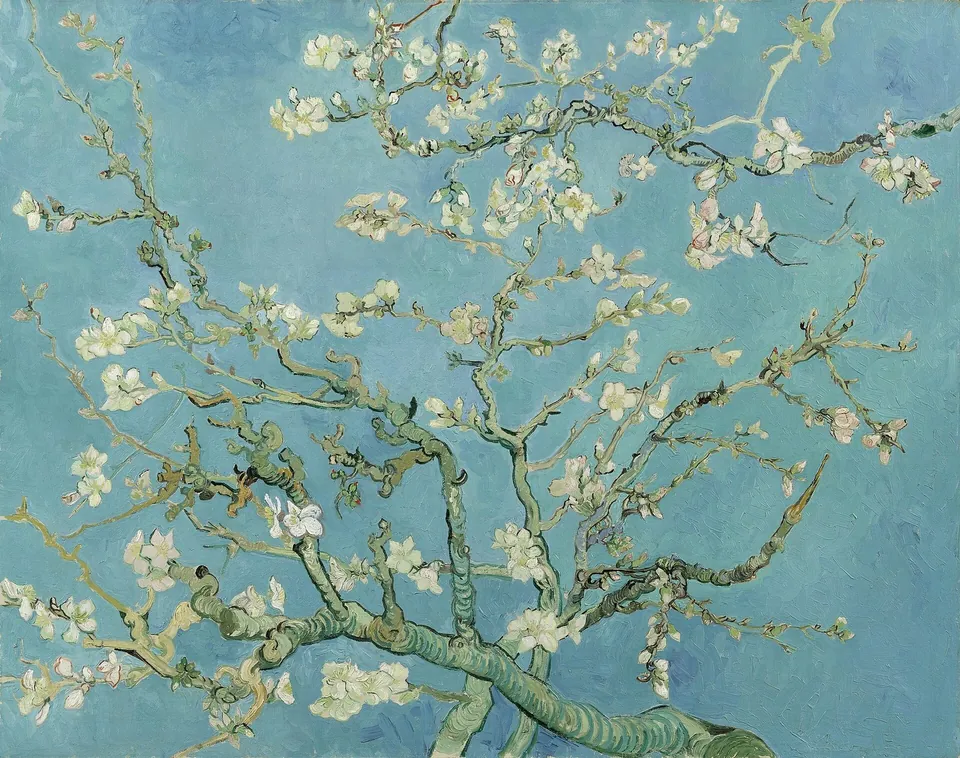
In February 1890 Theo van Gogh wrote from Paris that he had a son and named him Vincent. The painter, then a patient at the asylum in Saint-Rémy, answered with a gift: almond branches in bloom, the first tree to flower in Provence and a sign of new life, to hang over the baby's bed. He set them against a clear sky, no ground, no horizon. The bold cropping and flat outlines show his love of Japanese prints. The family kept it until the museum was founded.
What is in the painting
- Branches, no trunk. You never see the tree itself, only gnarled branches entering from the edges of the canvas.
- Turquoise sky. The background is one flat wall of blue-green: no clouds, no horizon line.
- White petals. The blossoms are white with pink shadows and some buds are still closed: earliest spring.
Did you know? The baby the painting was made for, Vincent Willem van Gogh, grew up to found the Van Gogh Museum in Amsterdam.
About the painting
- Artist
- Vincent van Gogh (1853–1890)
- Year
- 1890
- Style
- Post-Impressionism
- Medium
- Oil on canvas
- Size
- 73.3 × 92.4 cm
- Where to see it
- Van Gogh Museum, Amsterdam
How to describe it in Speakasso
In Speakasso you describe the painting in your own words and an AI draws it again. These words are forbidden in this round — each one costs 15 points:
A description that scores high
Gnarled, twisting boughs enter from the edges of the picture and spread across it, with no trunk, ground or horizon. They are dotted with small white blooms with pink shadows, and some buds are still closed. Behind them is one flat wall of bright turquoise blue-green, with no clouds at all. Dark brown boughs with dark outlines. Flat shapes and bold cropping, like a Japanese print, painted with thick short strokes.
The tricky part: Say gnarled brown boughs cross a flat turquoise backdrop, covered in small white blooms with pink shadows, no trunk visible.
The method behind it: what is painted first, then where things are, then colour and light, then the style. Read the full guide
More by Vincent van Gogh in the game