Speakasso › Paintings › Mona Lisa
Mona Lisa
Leonardo da Vinci, 1503
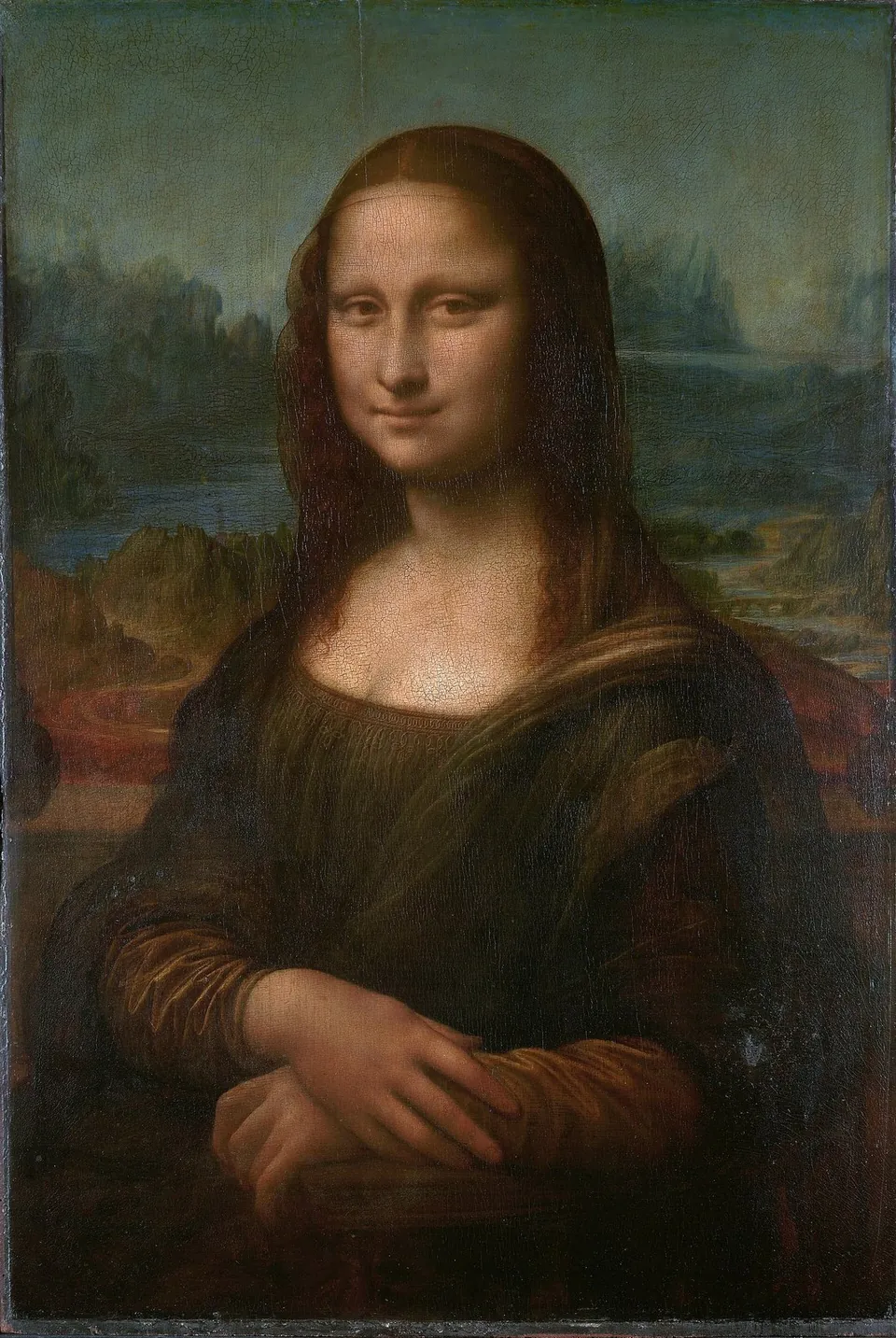
A modest portrait of a Florentine woman, most likely Lisa Gherardini, wife of the silk merchant Francesco del Giocondo. Leonardo worked on it for years and never delivered it: the panel travelled with him to France and entered the collection of King Francis I after his death. The famous half-smile comes from sfumato, the edges of mouth and eyes dissolved in haze, so the expression seems to shift depending on where you look. Behind her stretches an imaginary landscape of road, bridge and water fading into blue distance.
What is in the painting
- Folded hands. The right hand rests calmly on the left, on the arm of a chair.
- Dark veil. A thin transparent veil over loose hair, and no jewellery at all.
- Two horizons. The landscape to the left and right of her head sits at different heights.
Did you know? In 1911 the painting was stolen from the Louvre by a museum worker, Vincenzo Peruggia, and stayed missing for two years; even Picasso was questioned as a suspect.
About the painting
- Artist
- Leonardo da Vinci (1452–1519)
- Year
- 1503
- Style
- High Renaissance
- Medium
- Oil on poplar panel
- Size
- 77 × 53 cm
- Where to see it
- Louvre, Paris
How to describe it in Speakasso
In Speakasso you describe the painting in your own words and an AI draws it again. These words are forbidden in this round — each one costs 15 points:
A description that scores high
A lady with long dark hair sits half-turned toward us, shown from the waist up, her right hand resting on her left on the arm of a chair. The corners of her lips curve up very slightly, calm and a bit mysterious. Behind her stretches a hazy far-off valley with winding roads, a small bridge and misty blue water. Soft brown and olive tones, dim warm light. Smooth, blurry old oil painting on wood.
The tricky part: For the famous expression, say the corners of her lips curve up slightly while the rest of her face stays calm.
The method behind it: what is painted first, then where things are, then colour and light, then the style. Read the full guide