
Speakasso › Paintings › The Rooks Have Returned
The Rooks Have Returned
Alexei Savrasov, 1871
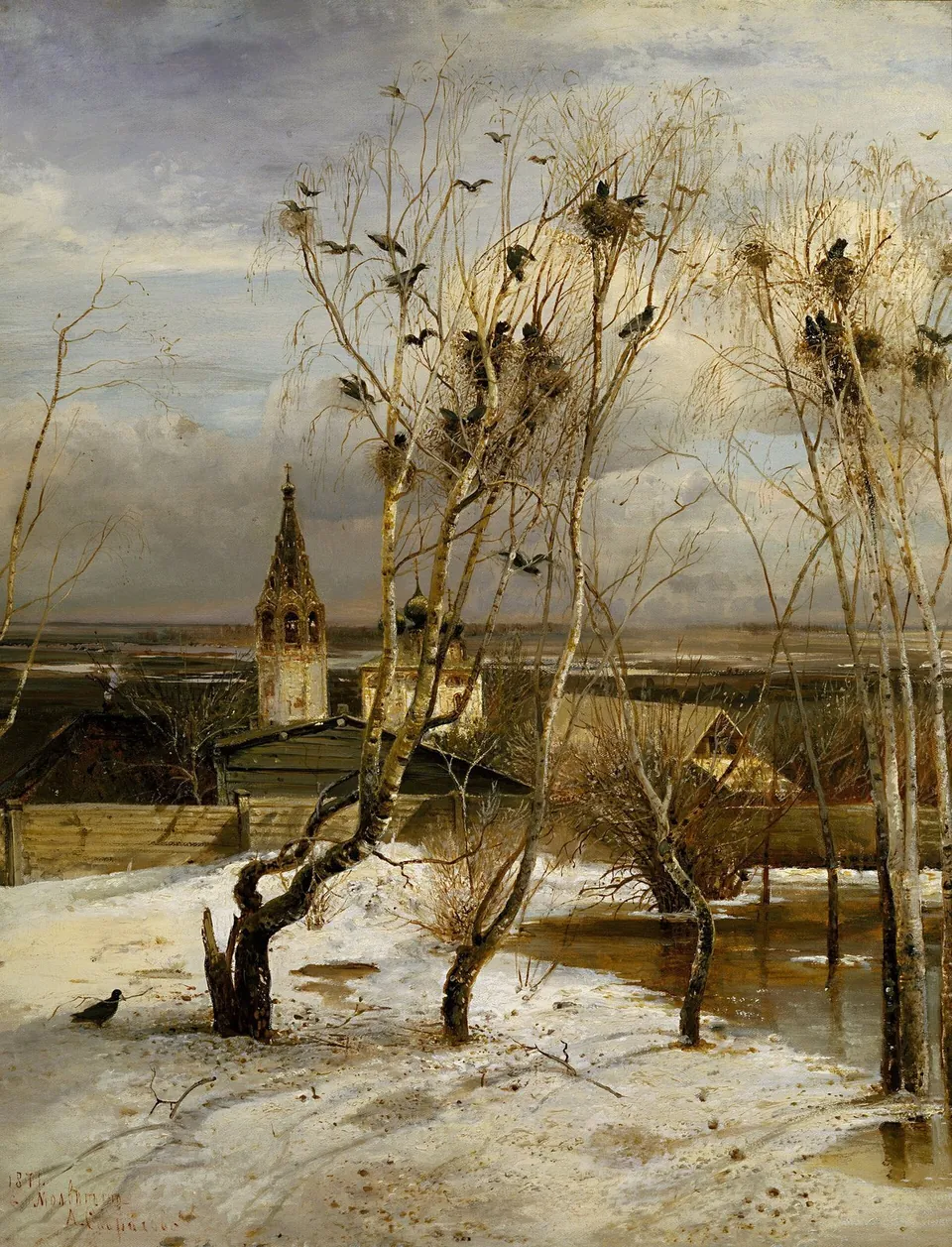
Melting snow, crooked birches with nests, an old tent-roofed bell tower and a wet grey sky: nothing remarkable, it would seem. Yet this modest picture, shown at the first Peredvizhniki exhibition in 1871, gave birth to the Russian lyrical landscape. Savrasov made his studies in the village of Molvitino in Kostroma province and finished the work in Moscow. Kramskoi remarked that there were many fine landscapes at the show, but only The Rooks had a soul. Pavel Tretyakov bought it at once; Savrasov's pupil Levitan called it the start of a new era.
What is in the painting
- Nests in the branches. Dark nests dot the tops of the bare birches and birds bustle around them.
- Tent-roofed bell tower. Beyond the fence stands a white church with a pointed bell tower.
- Meltwater. At the bottom the snow has darkened and thawed into a pool.
Did you know? The village of Molvitino where the picture was painted is now called Susanino, and the church it depicts houses a museum devoted to the folk hero Ivan Susanin.
About the painting
- Artist
- Alexei Savrasov (1830–1897)
- Year
- 1871
- Style
- Realism, lyrical landscape
- Medium
- Oil on canvas
- Size
- 62 × 48.5 cm
- Where to see it
- Tretyakov Gallery, Moscow
How to describe it in Speakasso
In Speakasso you describe the painting in your own words and an AI draws it again. These words are forbidden in this round — each one costs 15 points:
A description that scores high
An early thaw in a quiet country scene. In the foreground, a cluster of crooked white-barked trunks with bare twigs, their tops dotted with dark nests, black birds bustling around them. Beyond a wooden fence stands an old white bell tower with a tent-shaped roof. The ground is still white but melting, with a dark puddle of meltwater at the bottom. Grey-blue overcast sky, soft muted light. Modest, lyrical, realistic oil painting.
The tricky part: Say crooked white-barked trunks with dark nests, and the ground still white but melting into a dark pool.
The method behind it: what is painted first, then where things are, then colour and light, then the style. Read the full guide