
Speakasso › Paintings › Black Square (1915)
Black Square (1915)
Kazimir Malevich, 1915
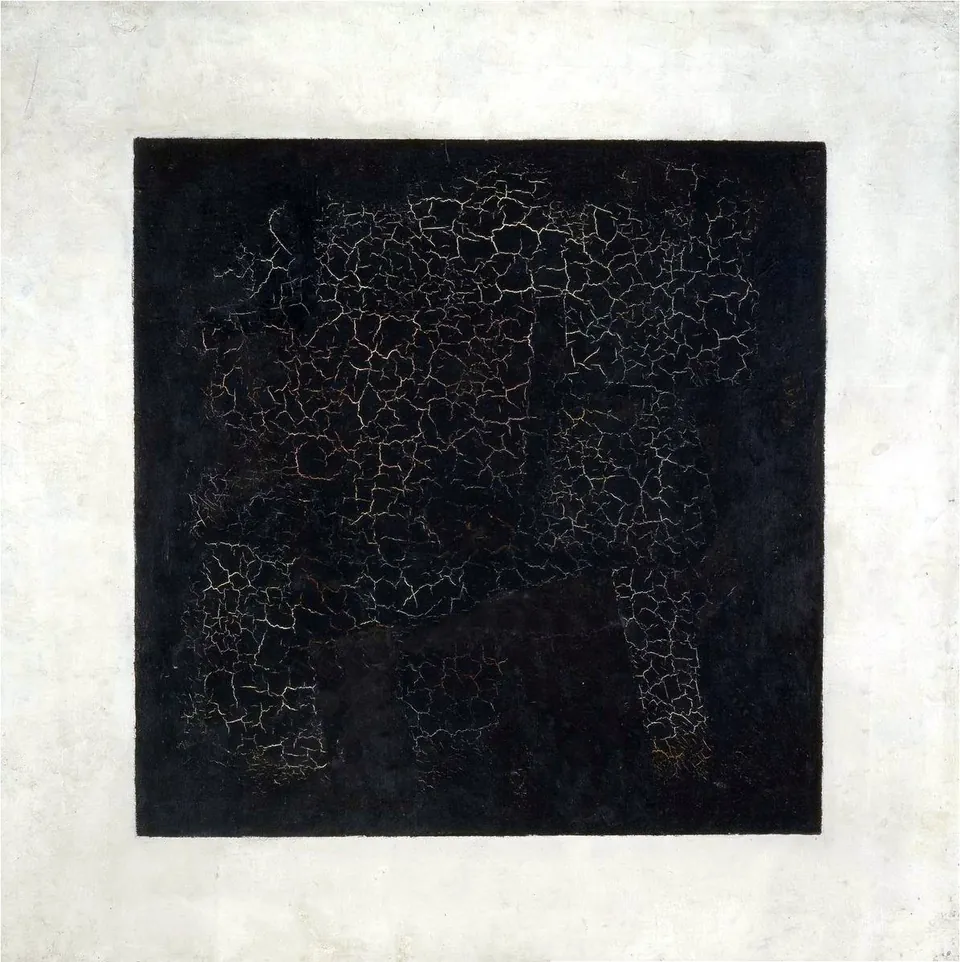
In December 1915, at the exhibition 0,10 in Petrograd, Malevich hung a black square on white in the upper corner of the room, where an icon hangs in a Russian home. He declared it the zero of form, the point after which painting no longer needed to depict the world. The square is not perfect: its sides are slightly uneven, and the black paint has cracked into a web through which coloured layers show. Malevich painted three more versions, but this first one remains the manifesto of non-objective art.
What is in the painting
- Uneven sides. The square is not strictly geometric: its lines waver slightly and its corners are not true right angles.
- White border. A narrow band of white, itself visibly brushed, surrounds the black shape.
- Web of cracks. The black surface is covered in craquelure, with other colours peeping through the cracks.
Did you know? X-rays in 2015 revealed two earlier coloured compositions beneath the square and a pencil inscription that echoes an all-black joke picture by the 19th-century humorist Alphonse Allais.
About the painting
- Artist
- Kazimir Malevich (1879–1935)
- Year
- 1915
- Style
- Suprematism
- Medium
- Oil on canvas
- Size
- 79.5 × 79.5 cm
- Where to see it
- Tretyakov Gallery, Moscow
How to describe it in Speakasso
In Speakasso you describe the painting in your own words and an AI draws it again. These words are forbidden in this round — each one costs 15 points:
A description that scores high
One large, very dark block with four equal sides sits in the middle of the canvas, the color of coal or soot. Around it runs a narrow off-white border with visible brush marks. The shape isn't perfectly geometric: its sides waver slightly and the corners aren't quite true. The dark paint is old and covered in a fine web of tiny fissures, with other colors peeping through. Nothing else. Flat, simple abstract painting.
The tricky part: Describe a coal-dark block with four equal sides on off-white, and call the aging surface a web of tiny fissures.
The method behind it: what is painted first, then where things are, then colour and light, then the style. Read the full guide