Speakasso › Paintings › The Gleaners
The Gleaners
Jean-François Millet, 1857
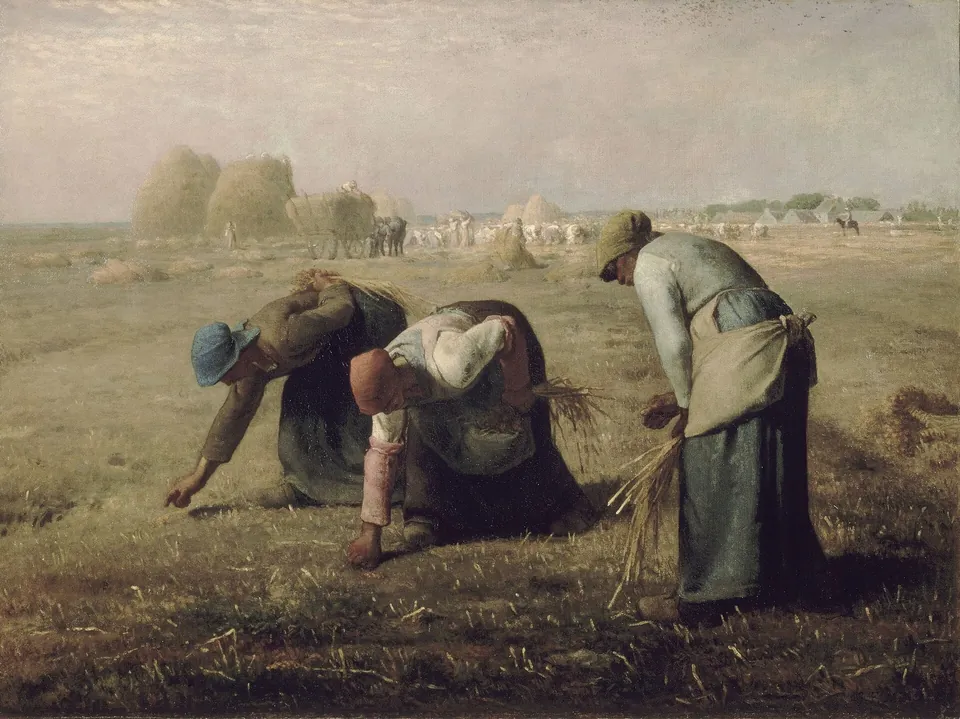
Three peasant women stoop over a harvested field, gathering the leftover ears of grain, an ancient right of the poorest. Far behind them, bathed in golden light, the real harvest goes on: huge stacks, carts, an overseer on horseback. Millet worked on the theme for a decade and gave his figures an almost classical monumentality. Critics in 1857 saw a social threat in the picture, 'the three Fates of poverty'. Today it is one of the most recognisable images of rural life in Western art.
What is in the painting
- Three bent backs. Two women are bent double, the third has half straightened up.
- Coloured kerchiefs. Red, blue and yellow headscarves.
- Distant harvest. Along the horizon: stacks, a cart, a rider and a crowd of workers.
Did you know? The French state declined to buy the painting in 1857; it entered the Louvre only in 1890 as a gift from the widow of the champagne magnate Pommery.
About the painting
- Artist
- Jean-François Millet (1814–1875)
- Year
- 1857
- Style
- Realism
- Medium
- Oil on canvas
- Size
- 83.5 × 110 cm
- Where to see it
- Musée d'Orsay, Paris
How to describe it in Speakasso
In Speakasso you describe the painting in your own words and an AI draws it again. These words are forbidden in this round — each one costs 15 points:
A description that scores high
Three peasant ladies in rough work clothes stoop in the foreground of a flat, harvested stubble plain, picking up leftover grain stalks. Two bend double; the third is half upright. They wear red, blue and yellow headscarves. Far behind them, in golden haze, stand huge mounds of harvested grain, a cart, a rider and a crowd of workers. Warm earthy browns, golden evening light. Heavy, solid figures, soft realistic oil painting.
The tricky part: Call them three stooping peasant ladies in colored headscarves, and the distant stacks huge golden mounds of harvested grain.
The method behind it: what is painted first, then where things are, then colour and light, then the style. Read the full guide
More by Jean-François Millet in the game