Speakasso › Paintings › Barge Haulers on the Volga
Barge Haulers on the Volga
Ilya Repin, 1870
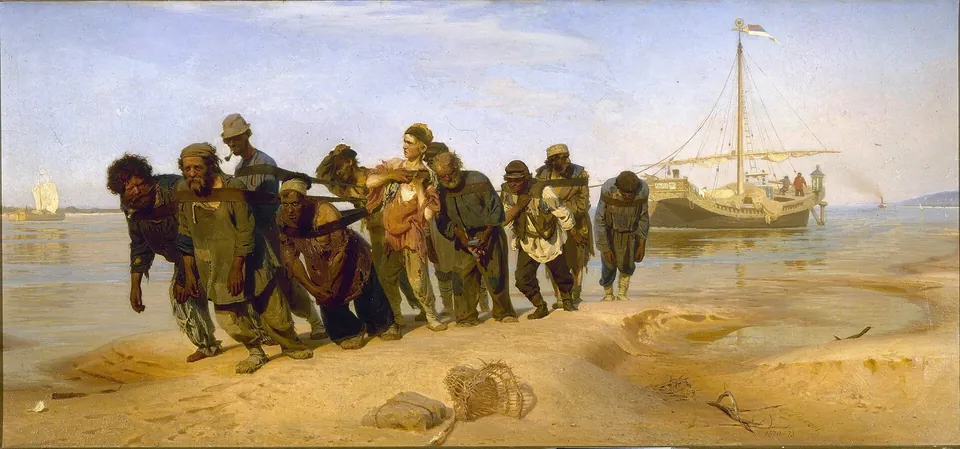
Eleven men strapped into harnesses drag a heavy barge along a sandy bank. Repin was barely in his twenties when, in summer 1870, he travelled to the Volga and befriended the haulers; every figure is painted from a real person. At the front is Kanin, a defrocked priest, whose face the artist regarded as his greatest success. On the horizon a steamboat smokes: the mechanical power that will soon make such labour obsolete. The painting brought Repin nationwide fame; Dostoevsky admired that it contained not a drop of moralising.
What is in the painting
- Youth in pink. At the centre a young hauler in a pale shirt adjusts his strap, the one bright note.
- Distant steamer. On the right horizon the smoke of a steamboat is visible.
- Low horizon. A vast pale sky and a flat strip of sand; the figures march straight towards us.
Did you know? The painting was bought by Grand Duke Vladimir Alexandrovich for three thousand roubles and hung in his billiard room.
About the painting
- Artist
- Ilya Repin (1844–1930)
- Year
- 1870
- Style
- Realism
- Medium
- Oil on canvas
- Size
- 131.5 × 281 cm
- Where to see it
- Russian Museum, St Petersburg
How to describe it in Speakasso
In Speakasso you describe the painting in your own words and an AI draws it again. These words are forbidden in this round — each one costs 15 points:
A description that scores high
Eleven ragged, sunburned men trudge straight toward us along a flat bank, leaning forward into leather harness straps as they drag a big wooden cargo vessel behind them. In the middle, a young man in a pale pink shirt adjusts his strap. Behind them stretch wide calm water, a vast pale sky and a tiny steamboat smoking far off on the right. Dusty ochre, beige and brown, hot bright light. Gritty, realistic oil painting.
The tricky part: Say men leaning into leather harness straps drag a big wooden cargo vessel along a flat pale-yellow bank.
The method behind it: what is painted first, then where things are, then colour and light, then the style. Read the full guide
More by Ilya Repin in the game