
Speakasso › Paintings › The Ninth Wave
The Ninth Wave
Ivan Aivazovsky, 1850
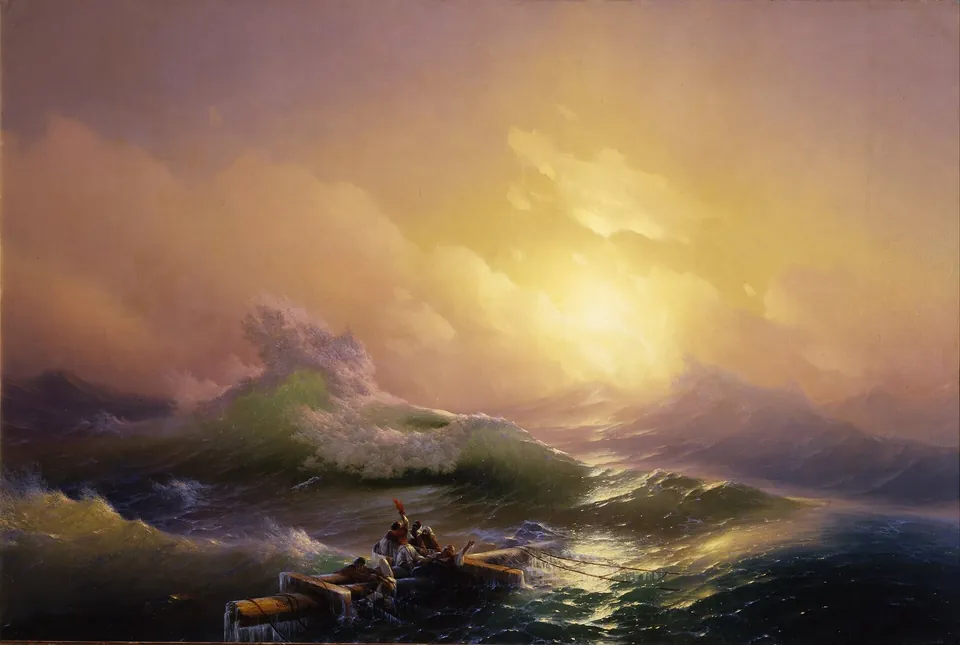
The night has passed and the rising sun turns the raging sea to green gold. A handful of sailors cling to a piece of mast as a huge wave bears down on them, by sailors' lore the ninth, the most terrible. Yet the light is so warm that the painting is about hope rather than doom. Aivazovsky painted it at 33, already a celebrated marine painter, and he never worked from nature on the shore: he memorised the sea and painted it in the studio, sometimes in a matter of days. It became the best known of his roughly six thousand works.
What is in the painting
- Men on wreckage. Several figures cling to a piece of mast at lower left, one waving.
- Translucent wave. A giant swell of green glass with light passing through it.
- Golden sunrise. The sun breaks through cloud, flooding sky and water in yellow-pink.
Did you know? Aivazovsky was so famous in his lifetime that Turner wrote a poem in his honour and the Pope bought one of his paintings.
About the painting
- Artist
- Ivan Aivazovsky (1817–1900)
- Year
- 1850
- Style
- Romanticism
- Medium
- Oil on canvas
- Size
- 221 × 332 cm
- Where to see it
- State Russian Museum, Saint Petersburg
How to describe it in Speakasso
In Speakasso you describe the painting in your own words and an AI draws it again. These words are forbidden in this round — each one costs 15 points:
A description that scores high
A raging sea at dawn after a night storm. In the lower left, a handful of sailors cling to a floating broken spar from their wrecked vessel, one of them waving. A giant swell of translucent green water rears up in the middle, glowing as light shines through it. Above, a golden-yellow glow breaks through the haze, flooding everything in warm yellow, pink and green. Dramatic, glossy, romantic oil painting.
The tricky part: Call it a giant translucent green swell, and say the men cling to a broken wooden spar while golden light breaks through.
The method behind it: what is painted first, then where things are, then colour and light, then the style. Read the full guide