Dance
Henri Matisse, 1910
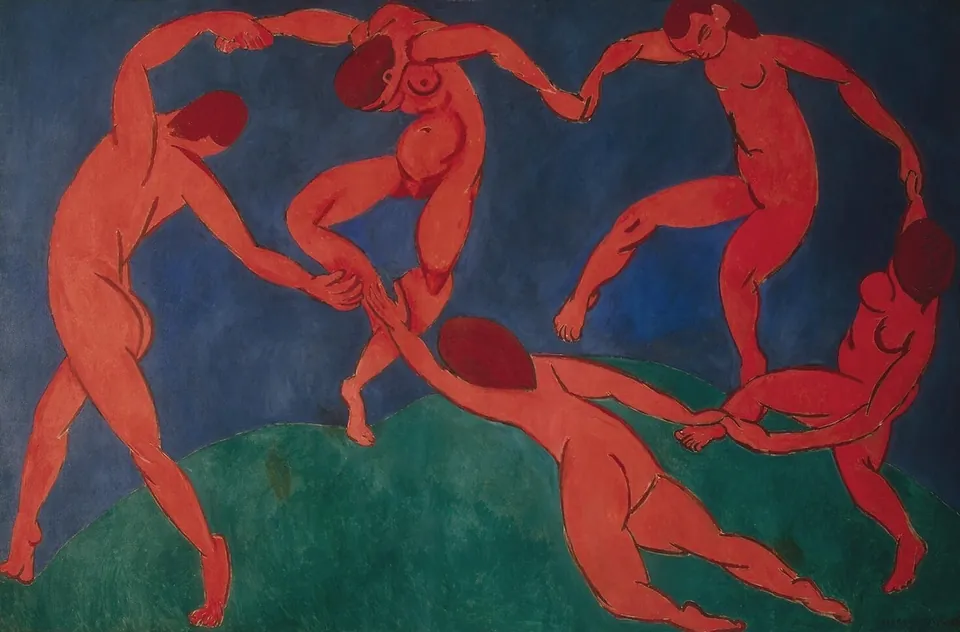
Moscow merchant Sergei Shchukin commissioned two panels from Matisse for the staircase of his mansion: Dance and Music. The painter limited himself to three colours: five brick-red nudes whirl in a ring over a green hill against a blue sky. Matisse said he took the rhythm from the farandole he had watched at the Moulin de la Galette in Paris. Shchukin, seeing the sketch, panicked at the nudity and cancelled the commission by telegram, then changed his mind days later. The earlier, paler version hangs in New York's MoMA.
What is in the painting
- Three colours. The entire picture is red bodies, green ground and blue sky, nothing else.
- Broken ring. Five figures hold hands, but at the front two hands fail to meet.
- Stretched bodies. The dancers are elongated and bent as if pulled by some unseen force.
Did you know? Matisse deliberately left a gap in the ring: the two figures in front cannot quite reach each other's hands, which is what makes the dance feel alive.
About the painting
- Artist
- Henri Matisse (1869–1954)
- Year
- 1910
- Style
- Fauvism
- Medium
- Oil on canvas
- Size
- 260 × 391 cm
- Where to see it
- Hermitage Museum, Saint Petersburg
How to describe it in Speakasso
In Speakasso you describe the painting in your own words and an AI draws it again. These words are forbidden in this round — each one costs 15 points:
A description that scores high
Five naked brick-red figures whirl in a ring, holding each other by the wrists, on top of a rounded bright green mound. Their bodies are long, bent and stretched, as if pulled by the spin. At the front, two of them reach for each other but don't quite connect, leaving a gap. Behind them everything is flat deep blue. Only three colors: red, green and blue. Simple bold shapes, flat paint, loose outlines.
The tricky part: Say five red figures spin in a ring holding wrists, on a green mound against flat deep blue, with one gap at the front.
The method behind it: what is painted first, then where things are, then colour and light, then the style. Read the full guide
More by Henri Matisse in the game