Speakasso › Paintings › Bal du moulin de la Galette
Bal du moulin de la Galette
Pierre-Auguste Renoir, 1876
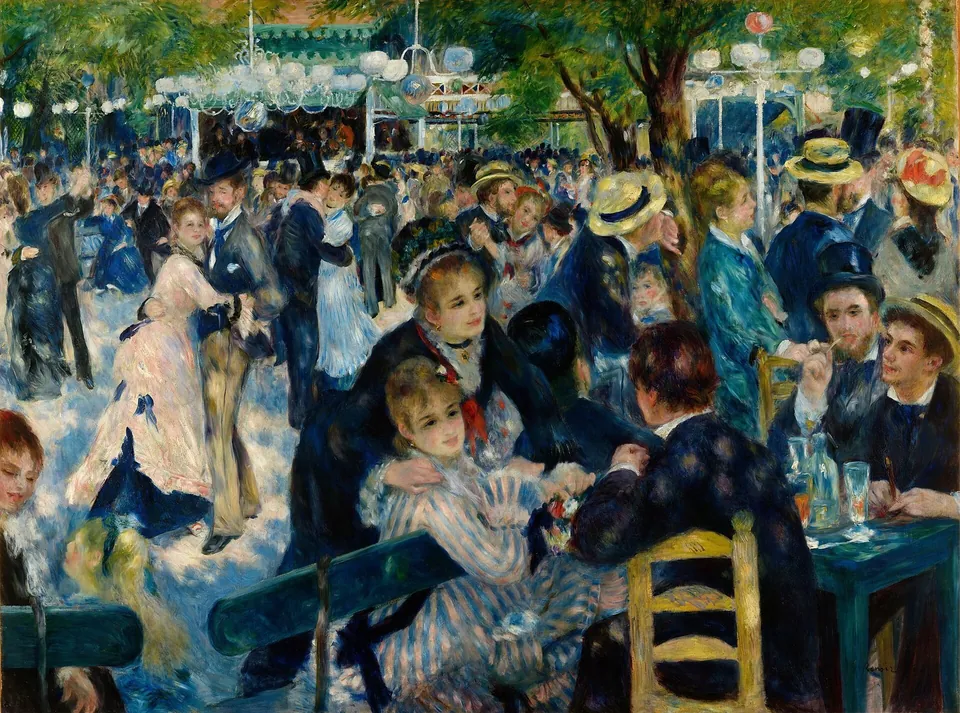
A Sunday afternoon on Montmartre: young Parisians dance, drink and chat under the acacias while dappled sunlight skips over dresses and straw hats. Renoir painted this open-air dance garden beside an old windmill every Sunday, hauling the large canvas over from his studio with the help of friends. His painter companions and local girls, seamstresses and milliners, posed for the figures. There is no story, only the happiness of a crowd in the light. It is the most famous scene of Parisian leisure ever painted.
What is in the painting
- Patches of light. Round sunspots on the back of a man's dark jacket.
- Sisters up front. A girl in a striped dress leans on a bench beside her sister.
- White globe lamps. Round gas lamps hang above the crowd.
Did you know? Renoir's smaller version of the painting sold in 1990 for $78 million, at the time the second-highest price ever paid for a work of art.
About the painting
- Artist
- Pierre-Auguste Renoir (1841–1919)
- Year
- 1876
- Style
- Impressionism
- Medium
- Oil on canvas
- Size
- 131 × 175 cm
- Where to see it
- Musée d'Orsay, Paris
How to describe it in Speakasso
In Speakasso you describe the painting in your own words and an AI draws it again. These words are forbidden in this round — each one costs 15 points:
A description that scores high
A crowded open-air dance in a leafy garden on a sunny afternoon. In the front, a girl in a pink-and-blue striped dress leans on a wooden seat beside her sister, chatting with young men at a table on the right. Behind them couples waltz and a crowd mingles under the trees, with round white globe lights hanging above. Round spots of sunlight dapple dark jackets and straw boaters. Soft, shimmering, feathery brushstrokes.
The tricky part: Call the lighting round white glass globes hanging overhead, and describe round spots of sunlight dappling the dark jackets.
The method behind it: what is painted first, then where things are, then colour and light, then the style. Read the full guide