Speakasso › Paintings › The Card Players
The Card Players
Paul Cézanne, 1893
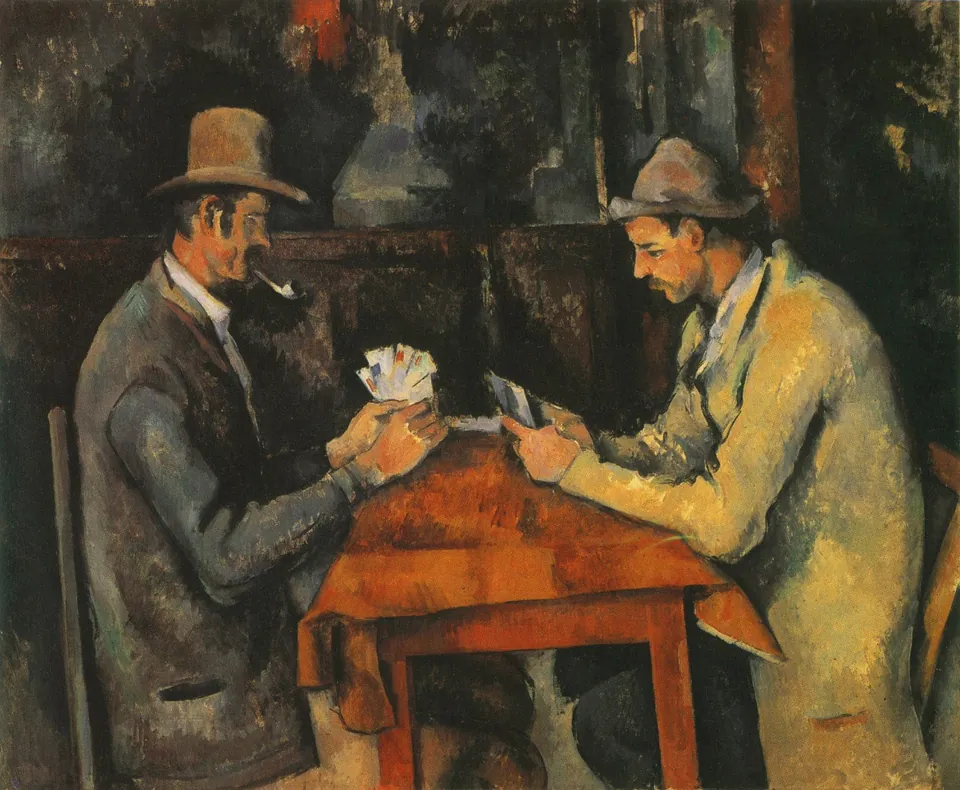
In the early 1890s Cézanne painted five pictures of card players, using farmhands from his family's estate near Aix as models. The earliest versions are crowded, but he kept stripping the scene down until only two men, a table and a single bottle between them remained. There is no drama: the players are absorbed and still, as if posing for a still life. That gravity and monumentality of ordinary figures later enthralled the Cubists. One version of the series was sold to Qatar in 2011 for a record sum.
What is in the painting
- Two in profile. The men face each other in profile, bent over their cards.
- Bottle in the middle. A bottle stands exactly between them, splitting the picture into two near-mirror halves.
- Pipe and hats. The left player smokes a pipe; both wear hats and workmen's jackets.
Did you know? The version bought by the Qatari royal family in 2011 reportedly cost around 250 million dollars, then the highest price ever paid for a painting.
About the painting
- Artist
- Paul Cézanne (1839–1906)
- Year
- 1893
- Style
- Post-Impressionism
- Medium
- Oil on canvas
- Size
- 47.5 × 57 cm
- Where to see it
- Musée d'Orsay, Paris
How to describe it in Speakasso
In Speakasso you describe the painting in your own words and an AI draws it again. These words are forbidden in this round — each one costs 15 points:
A description that scores high
Two farmhands sit facing each other in profile, leaning over a small game, each holding a fan of little white paper rectangles. A single dark wine flask stands exactly between them, splitting the scene into two near-mirror halves. The man on the left smokes a white pipe; both wear brimmed caps and work jackets. Muted browns, ochres, purple-blue and grey-green, plain wall behind. Solid, blocky shapes with visible patchy brushstrokes.
The tricky part: Say each man holds a fan of small white paper rectangles, with a single dark wine flask exactly between them.
The method behind it: what is painted first, then where things are, then colour and light, then the style. Read the full guide
More by Paul Cézanne in the game