Speakasso › Paintings › Woman with a Parasol – Madame Monet and Her Son
Woman with a Parasol – Madame Monet and Her Son
Claude Monet, 1875
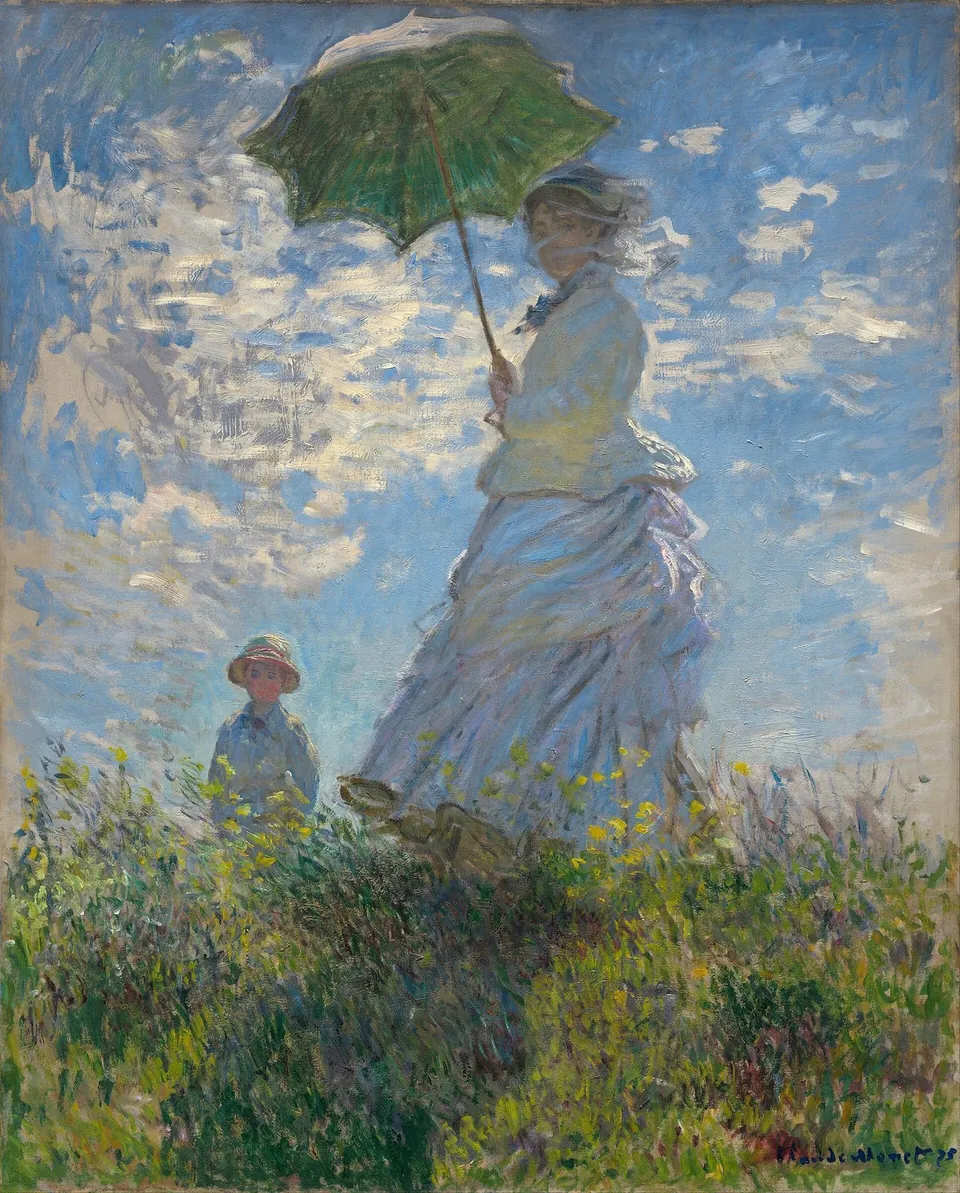
The artist's wife Camille stands on a hilltop against the light; the wind tugs at her veil and white dress, and a little lower, among the grass, their son Jean looks on. We see her from below, as if climbing the slope ourselves. Monet painted the picture at Argenteuil in a few hours with broad, rapid strokes, colouring the shadows on the dress blue and green rather than grey. It is one of the happiest family scenes of Impressionism and one of the last to show Camille, who died in 1879.
What is in the painting
- Flying veil. A green veil streams out behind the woman's head.
- Child in the grass. A small figure in a hat is visible from the waist up beyond the crest.
- Racing clouds. The sky fills most of the canvas with fast, white clouds.
Did you know? A decade later Monet repeated the motif with his stepdaughter Suzanne, this time deliberately leaving her face blank.
About the painting
- Artist
- Claude Monet (1840–1926)
- Year
- 1875
- Style
- Impressionism
- Medium
- Oil on canvas
- Size
- 100 × 81 cm
- Where to see it
- National Gallery of Art, Washington
How to describe it in Speakasso
In Speakasso you describe the painting in your own words and an AI draws it again. These words are forbidden in this round — each one costs 15 points:
A description that scores high
A young mother in a long white dress stands on a hilltop, seen from slightly below, holding a green sunshade over her head against the light. The wind tugs at her dress, and her green veil streams behind her. Lower down on the right, a small child in a hat peeks over the crest. Most of the picture is bright blue sky with fast white wisps. Breezy summer light, blue-green shadows. Quick, loose, sketchy brushstrokes.
The tricky part: Call it a green sunshade held up against the light, fill the sky with fast white wisps, and add a small child in a hat.
The method behind it: what is painted first, then where things are, then colour and light, then the style. Read the full guide
More by Claude Monet in the game