
Speakasso › Paintings › Wanderer above the Sea of Fog
Wanderer above the Sea of Fog
Caspar David Friedrich, 1818
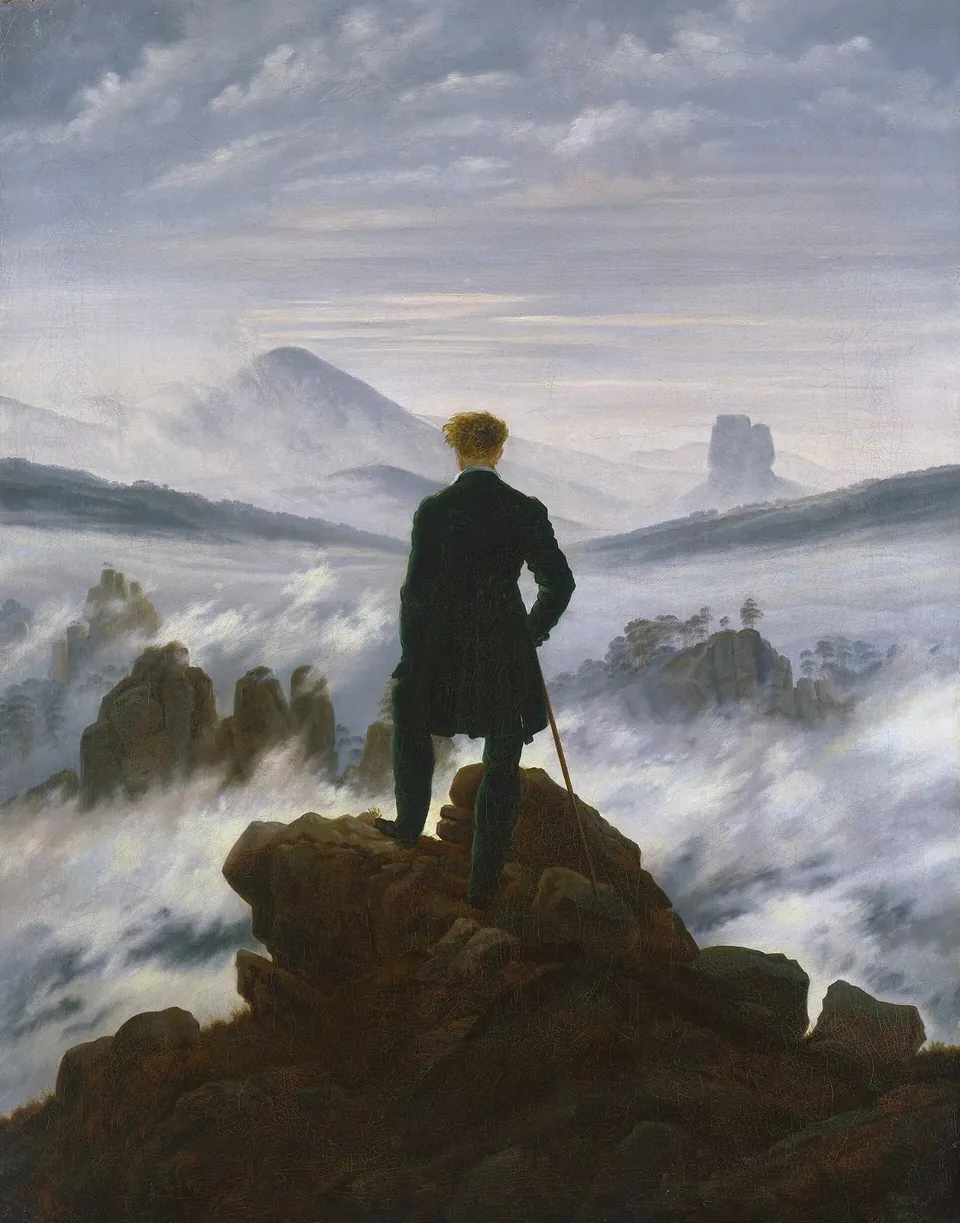
A man in a dark coat stands on a summit with his back to us, gazing down at swirling fog from which crags and distant mountains emerge. We never see his face and so slip into his place; this device, the figure seen from behind, became Friedrich's signature. The landscape is assembled from sketches of Saxon Switzerland, yet no such place exists. This painting of a man alone before infinity remained little known for a long time and only in the twentieth century became the most recognisable image of German Romanticism.
What is in the painting
- Figure from behind. A red-haired man with a cane stands on a dark rock.
- Sea of fog. White waves of mist fill the whole middle of the picture.
- Distant mountains. Crags rise out of the haze, with blue peaks far away.
Did you know? The wanderer's identity is unknown: some see a self-portrait, others a memorial to a fallen patriotic officer.
About the painting
- Artist
- Caspar David Friedrich (1774–1840)
- Year
- 1818
- Style
- Romanticism
- Medium
- Oil on canvas
- Size
- 95 × 75 cm
- Where to see it
- Hamburger Kunsthalle, Hamburg
How to describe it in Speakasso
In Speakasso you describe the painting in your own words and an AI draws it again. These words are forbidden in this round — each one costs 15 points:
A description that scores high
A man in a long dark green coat stands in the center on a jagged dark peak, seen from behind, one leg forward, leaning on a walking stick. His red hair blows in the wind. Below him, a thick white rolling mist fills the whole middle, with craggy outcrops poking through and pale blue summits far away. Cool blue-grey and white tones, soft hazy light. Smooth, calm, romantic oil painting.
The tricky part: Say thick white mist rolling below him like clouds, and give him a walking stick while he stands on a jagged dark peak.
The method behind it: what is painted first, then where things are, then colour and light, then the style. Read the full guide
More by Caspar David Friedrich in the game