Speakasso › Paintings › Arnolfini Portrait
Arnolfini Portrait
Jan van Eyck, 1434
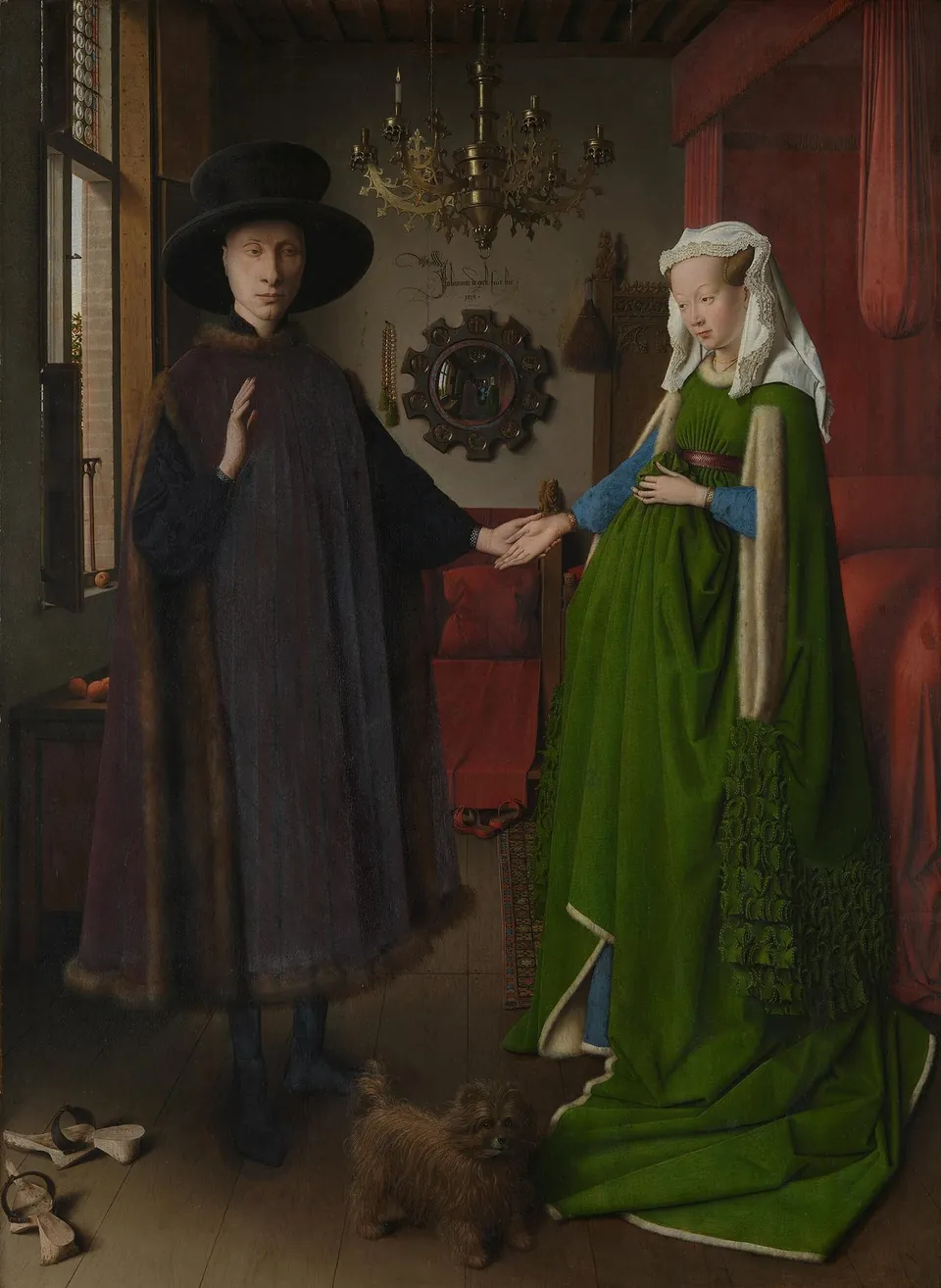
A man in an enormous hat and a woman in a green gown stand hand in hand in a bedroom of a house in Bruges. The patron was the Italian merchant Giovanni Arnolfini, but who stands beside him and what is happening, a betrothal, a wedding or simply a double portrait, is still debated. Van Eyck pushed oil painting to unprecedented precision: you can see the dog's fur, the oranges on the windowsill, the reflection in the convex mirror. On the wall above it he wrote: 'Jan van Eyck was here. 1434'.
What is in the painting
- Single candle. One candle burns in the brass chandelier though it is daylight outside.
- Red bed. On the right a heavy canopy and coverlet of scarlet cloth.
- Discarded shoes. Wooden clogs lie on the floor at left, red slippers near the bed.
Did you know? The tiny convex mirror on the back wall reflects two figures standing in the doorway, exactly where the viewer stands, and one of them may be the painter himself.
About the painting
- Artist
- Jan van Eyck (c. 1390–1441)
- Year
- 1434
- Style
- Northern Renaissance
- Medium
- Oil on oak panel
- Size
- 82.2 × 60 cm
- Where to see it
- National Gallery, London
How to describe it in Speakasso
In Speakasso you describe the painting in your own words and an AI draws it again. These words are forbidden in this round — each one costs 15 points:
A description that scores high
A man and a woman stand side by side in a small bedroom, holding hands. He wears a huge black round hat and a dark fur-trimmed coat; she wears a long green gown and holds up her skirt. A small fluffy pet stands at their feet. Behind them hangs a round convex looking glass, and above, a brass hanging light with one candle. Red bed on the right. Ultra-detailed, glossy oil painting.
The tricky part: Call the round thing on the back wall a convex looking glass, and the ceiling fixture a brass hanging light with one candle.
The method behind it: what is painted first, then where things are, then colour and light, then the style. Read the full guide
More by Jan van Eyck in the game