Speakasso › Paintings › The Tower of Babel
The Tower of Babel
Pieter Brueghel the Elder, 1563
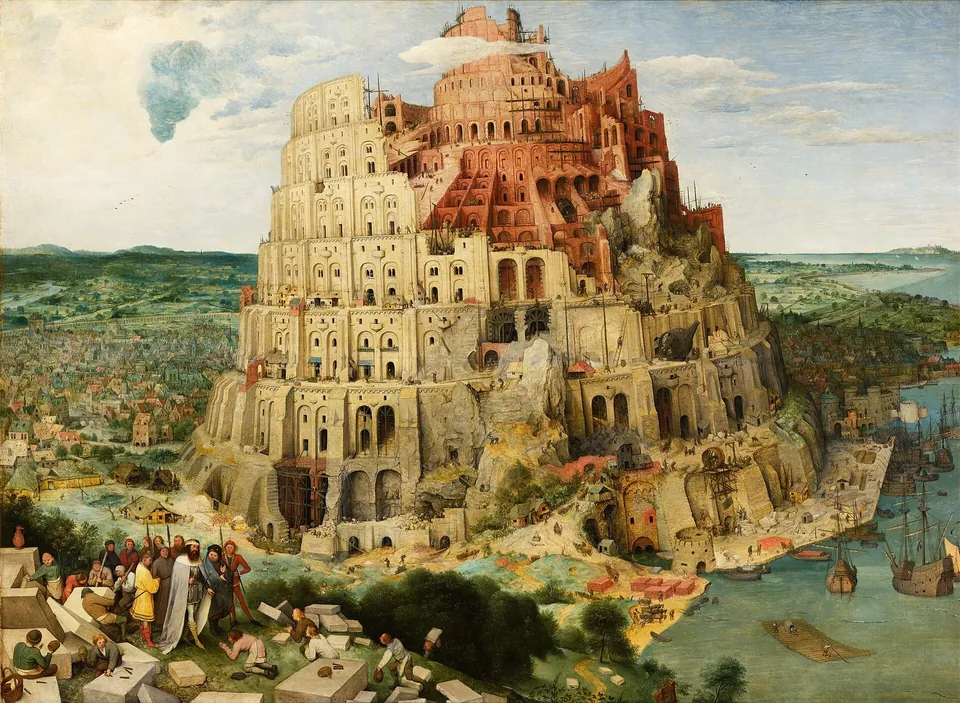
A gigantic spiral tower has risen from the Flemish plain and already brushes the clouds, though its lower storeys are still unfinished. Bruegel had been to Rome and clearly modelled it on the Colosseum: the same tiers of arches, twisted upward. In the foreground King Nimrod inspects the works while stonemasons fall to their knees, and ships unload in the harbour. Look closely: the tower leans noticeably and its levels do not line up. The project is doomed even before God confuses the builders' tongues.
What is in the painting
- Tiers of arches. The tower is ringed with rows of identical arched openings, like the Colosseum.
- The lean. The left side rises higher than the right; the whole structure tilts.
- Harbour below. At the foot on the right is a port with sailing ships and tiny cranes.
Did you know? Bruegel painted a second, half-size Tower of Babel, now in Rotterdam; a third, a miniature on ivory, is lost.
About the painting
- Artist
- Pieter Brueghel the Elder (c. 1525–1569)
- Year
- 1563
- Style
- Northern Renaissance
- Medium
- Oil on oak panel
- Size
- 114 × 155 cm
- Where to see it
- Kunsthistorisches Museum, Vienna
How to describe it in Speakasso
In Speakasso you describe the painting in your own words and an AI draws it again. These words are forbidden in this round — each one costs 15 points:
A description that scores high
A gigantic round stone structure, like a lopsided wedding cake spiraling upward, fills the center, its unfinished top brushing the sky. Every level is ringed with rows of identical rounded openings, like the Colosseum, and the whole thing leans. At its foot on the right lies a busy harbor with sailing vessels; in the front left, a king visits kneeling stonemasons. Earthy browns and pinks, a tiny town all around. Extremely detailed old Flemish painting.
The tricky part: Describe it as a gigantic spiraling layer cake of stone, each level ringed with rows of rounded openings like the Colosseum.
The method behind it: what is painted first, then where things are, then colour and light, then the style. Read the full guide
More by Pieter Brueghel the Elder in the game